Wednesday, March 29, 2006

252. Kalidasa

Posted by Picasa

Arrows let loose from a thousand bows
spread like a stain across the skies:
a thousand arcs of danger descending.

Waiting and watching, the army defending
raise their shields with worried eyes:
Who will survive? Blind fortune knows!

A poem, cousin to such lethal darts,
can land, unexpected, in our hearts.

Friday, March 24, 2006

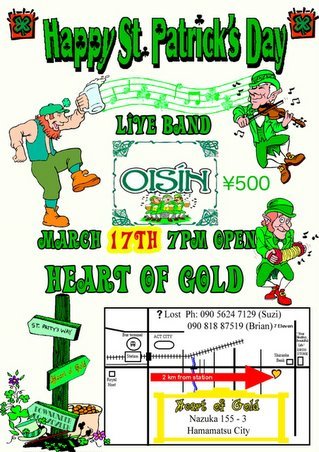
251. St. Paddy's Night - the Return of "Oisin"!!

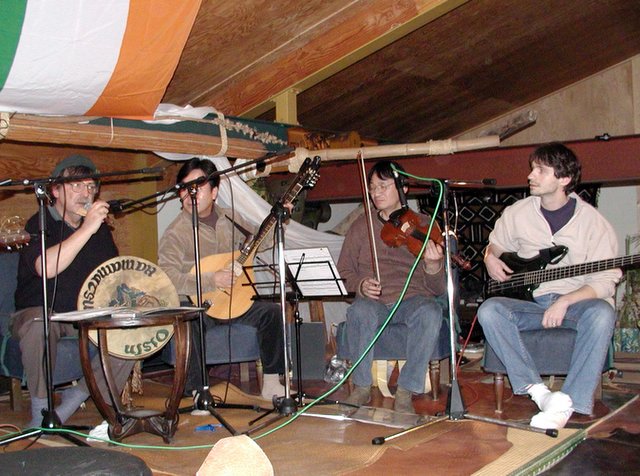
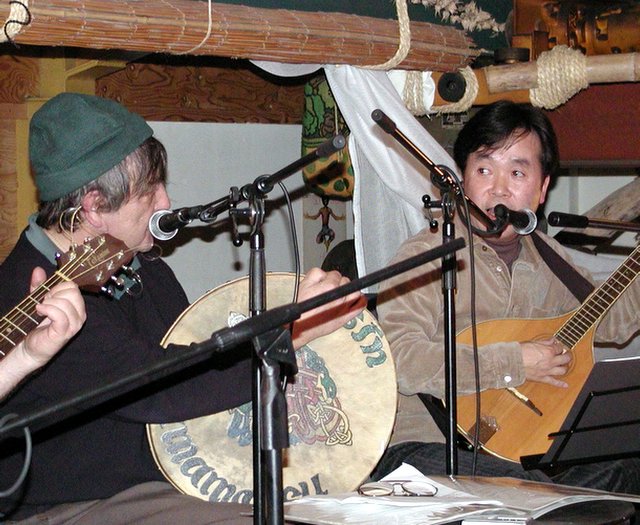
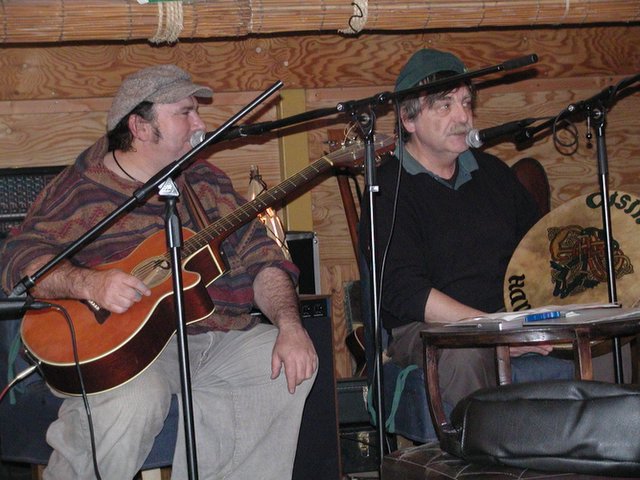
The band finally got back together after 3 years and everything seemed to click all over again. Kenji had been at me incessantly and Brian was encouraging. He and his mate Suzi (a bloke, not a girl)were fixing up a 2-storey wooden building and converting it into a bar. Brian asked us to open the place with the band on St. Patrick's night. Ah, sure, what can you say to that? We had only the one practice session on the previous Sunday but it went well. All the memories came back and we just needed to review the chord changes and get the timing down again. The building was still in a shambles with lumber, and tools, and pots of paint all over the place. 'Ah, it'll be grand on the night' said Brian. And it was! <br /> The first set was supposed to start around 8 but we never got rolling until after 9. Just like old times, in fact. It went pretty well but all of us thought the second set from half-ten on was much better since it got the crowd going ... of course, they'd had a lot more to drink by then!! The place looked great with loads of colourful posters of Ireland all over the walls, thanks to Bord Failte (Irish Tourist Board in Tokyo) who had sent them down along with a load of shamrock stickers as well -- ah, shure, daycent folk: go raibh maith agat!! A good number of people came -- a very good turnout considering everything had been done by word-of-mouth and slapped together at the last possible minute. At one point, in fact, I was passed a cellphone on the stage in a pause between songs and asked to give directions to a taxi driver. The boys were lost entirely!! Anyway, here are some photos of the night, courtesy of Ryuji Horiike. Ryuji was lepping around with his camera like ... a very good man. How else would we have these pictures otherwise? (And I know you thought I was going to say lepping around like a leprechaun ... God, the minds we call our own). The lineup, from the left in the picture above, is Kenji (guitar, flute, tin whistle), Brian (guitar, vocals), myself (bodhran, vocals) Satoshi (bouzouki, vocals), Matsu (fiddle), and Tibor (bass). Sláinte Éireann Gael go leor!!


What do you call a drummer? Some eejit who hangs around with musicians. Ryuji sent along a lot of pictures of this pesky craythur and not enough of the band ...!!

Monday, March 20, 2006

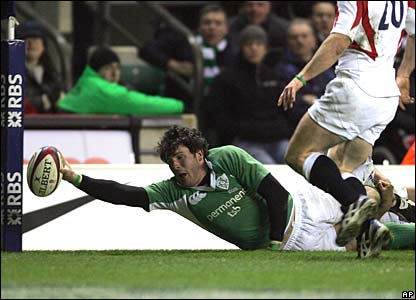
250. Ireland 28 England 24


Shane Horgan scores in the final minute!!

With their third consecutive defeat of England, Ireland has won the Triple Crown for 2006. Although tied in first place with France for the overall Six Nations title (each team had four wins and a loss) France edged ahead for the title on point difference. Still, a very good year for the Irish team -- go maire sibh, buachaillí!!

Monday, March 13, 2006

Tuesday, February 28, 2006

248. Riots in Dublin


Crowds gather in O'Connell Street.

Last Saturday afternoon, February 25, a confrontation between two groups of demonstrators led to a small riot in central Dublin. A group of Northern Unionists under the name 'Love Ulster' had bussed down to Dublin with bands and Union Jacks with the intent of marching down O'Connell Street, Dublin's main thoroughfare. Had the march proceeded, they would have passed by the General Post Office where the Easter Rebellion against British rule in Ireland had been proclaimed in 1916. The professed aim of this group was to commemorate the Unionists who had died at the hands of the IRA during the Northern Troubles of 1969-97. Some Irish commentators dryly likened such naivety to a group of Taleban or Al Quaeda supporters proposing a march down New York's Fifth Avenue. Nevertheless, the government and all the political parties (including Sinn Fein) shrugged their shoulders, and advised the populace to ignore these people and just let them get on with it.

Unfortunately, an organized band of 200-300 hardline republicans thought differently and when they moved in to block the Unionist parade they came in direct conflict with the Gardai (Irish police).


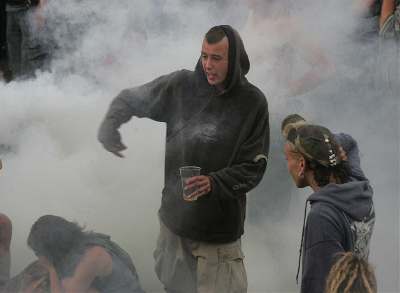
Smoke bombs, stones, and building materials were thrown by the protestors.

Construction is going on in O'Connell Street so a lot of useful material lay at hand for the demonstrators to throw at the police.The clashes were sporadic with several dozen injuries, many to the police, but hardly more than a skirmish compared to the riot of 1981 when tensions in the North were running very high.

The police pushed the demonstrators south of the river and several cars were overturned and torched in Nassau Street before the rioters and their hangers-on (mainly inner-city youth in hoodies with scarves pulled over their faces) decided to call it a day and go home to their tea. The cars targeted were Mercs and BMWs which says a lot more about economic disparities than the national question.

In 1981, during the IRA Hunger Strike, there was a serious riot in which thousands took part and which led to the burning down of the British Embassy. Saturday's events were minor by comparison, but the return of violence to the streets of Dublin came as a very unwelcome wake-up call to the country's leaders and the complacent majority of the population who had hoped and believed that the passions aroused by the continuing partition of the island had largely subsided since the 1998 Good Friday Agreement.


Gardai in Nassau Street.

Today's editorial in the Irish Independent can be read here.

Sunday, February 26, 2006

247. Toh-Koh (Climbing Upwards)

Before you start: This poem should be considered as a translation. It is certainly not my own original work -- but, at the same time, it is.

There is a great deal more guesswork involved when translating from classical Chinese than, say, from a contemporary European language.

The signposts are the "Kanji" -- the Chinese ideographs. Each of them stands for a separate thing or action or idea. They act as concrete guidelines across the centuries but their juxtaposition and the absence of clues leaves a great deal open for modern interpretation.

What got me started was this: I got talking about this poem with a Japanese teacher at my school who teaches "Classics" (i.e. Chinese and early Japanese literature) and it soon became apparent that the standard English translation -- the one that shows up on dozens of sites on the Internet; every single site, in fact! -- was putting an interpretation on this text that was aesthetically pleasing (Western-style) but in some ways very inaccurate. It didn't respect the deliberate use of repetitive words, for one thing, and introduced the simile of "spray from a waterfall" which simply didn't exist in the original.

For that reason I decided to re-translate the poem. I don't know if I've done any better (and I'd be delighted to hear from anyone who reads Chinese!!) but I went back to the original -- as it was written 1250 years ago -- and took it from there. Here we go:

Climbing Upwards


Shen Zou 'Poet on a Mountain Top' Ming Dynasty ca. 1500

Under a cutting wind from the open sky, the monkeys are sadly keening,
Over clear lake waters, over white sands, the birds are flying home;
The autumn leaves come fluttering, fluttering down,
The never-ending river keeps flowing along, keeps flowing along ....

Ten thousand leagues, the sadness of an autumn traveller,
A hundred years of sorrows attend me, all alone I climb;
Misfortunes press down on me, there is frost upon my brow,
There are floods of weariness. Dust gathers in my wine cup.

Here's the standard translation:

In a sharp gale from the wide sky apes are whimpering,
Birds are flying homeward over the clear lake and white sand,
Leaves are dropping down like the spray of a waterfall,
While I watch the long river always rolling on.

I have come three thousand miles away. Sad now with autumn
And with my hundred years of woe, I climb this height alone.
Ill fortune has laid a bitter frost on my temples,
Heart-ache and weariness are a thick dust in my wine.

It's very similar ... but it's not the same.

You can check out the Chinese original (plus standard translation) at the following website

What is really cool about this site is that if you pass your cursor over any one of the Chinese characters, the English meaning will pop up. When I consider those many long years of 1000-page dictionaries .... !!

If you are still with me, check out the Kanji:

Wind - sharp/cutting/biting - heaven - high - monkey(s) - cry - lament;
Lake - clear/pristine/pure - sand - white -bird(s) - fly - return/revolve ;
Without - boundary - falling - tree - mournful- mournful - down
Not - limit - long - river/waters - roll - roll - come;
10,000 - Ri* - sad - autumn - always - made/constructed - guest;
100 - year(s) - many - illnesses - alone - climb - station;
difficult - disaster - bitter - hate - complicated - frost - temple/brow;
heavy rain - flood - new - stop/pause/settle/ -muddy/dusty - wine -cup

*Ri - a Chinese measure of distance

I have a visual understanding of this poem: I can feel what the guy is saying. Say what you will, but these poems are visual events, not just when printed, but in the controlled explosions of brushed ink on paper. Thank God for print -- they are almost totally illegible otherwise!

Finally, and I've been saving this for last, Tu Fu, or Du Fu -- To-Ho in Japanese -- was one of a pair of near-legendary poets who became famous (celebrities, superstars) within their own lifetimes during the T'ang Dynasty in China, a period which lasted from 618 to 906 AD. The T'ang interval is generally considered by most Chinese to be the introduction to the early-modern period of their long history. They had concluded their "Middle Ages" in about 1000 BC, around the time of the Battle of Troy. The other famous poet was Li Po, or Li Tai-po (Rihaku in Japanese), a wonderfully attractive person who features in an earlier posting on this Blog, entitled Ezra Pound in China

Thursday, February 09, 2006

246. Maureen Rua

This is a recycle of a previous post ... ages ago, lost in the mists of time .. but it's been on my mind for the last three days and I've rewritten a lot of the central part of it. I think it's because I've been listening to a lot of really good Irish music (the real stuff) thanks to Paddy & Bridget and their friends back in the County Clare and now I can see where it wasn't quite on the button the first time around. No guarantees it's "on the button" this time either, but it feels and reads better ...........

The character is a composite of several well-known beauties who lived on into the 1920s and 30s, women who had been much celebrated in story and song among country people during the latter part of the 19th century.


Them lands beyond
belong to strangers now,
says Maureen Rua
bringing the tea
over to the table,
the large pot in her
withered shaking hands,
and herself getting on
to a rare old age
now that Dinty's gone,
but with the scraps
of her wild red hair
still showing, and her eyes
undimmed: they had made her
the belle of five counties
back in the days
when the world was young.

Maureen Rua!
Some farmer's sons
fell close to self-destruction
for the love of you,
but they recovered
the run of themselves
after many stout blows
from the sticks of their fathers,
and through the blessings
of Holy Mother Church,
and through the less blessed
but far more fascinating
smiles and enticements
of the local sweet colleens.

There was the land
and she with no brothers.
It was the land, they said,
but it was never just the land:
it was you, Maureen Rua,
that had them so bedazzled,
you, with your sparkling eyes,
your soft full figure,
your tumbling, tangling
wild red hair.

O Maureen Rua
how my heart goes out to you
with the song of the lark
in the clear morning air,
and in the bee-buzzing afternoon
my same heart stumbles,
then lazily lingers
with sweet honey thoughts;
and in the evening, yes,
I sing along, softly,
with the shy nightingales.

All for you, Maureen Rua.

You are old now, a widow,
saddened and past innocence,
awaiting your final repose;
but you are still the finest
among the "m'nah nuh Hay-rinn",
champing on your false teeth
and not so sure of your gamy legs,
as you bring the tea this very minute
with uncertain steps
here to the table.

Ah, Maureen Rua,
Maureen Rua!
The finest woman
in God's creation!


* mnaa na hEireann - (Gaeilge) the Women of Ireland. They actually run our country right now from the President on down -- perhaps not such a bad thing .

Thursday, February 02, 2006

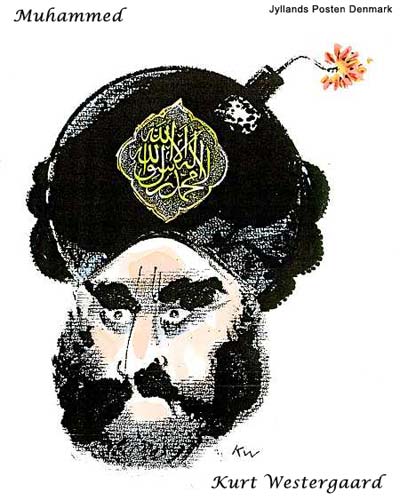
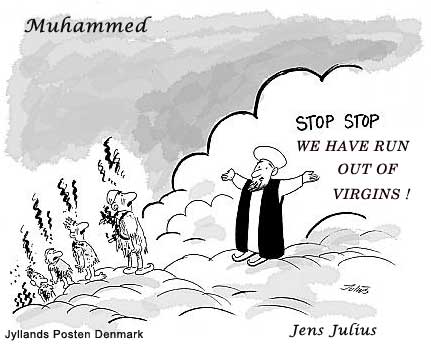
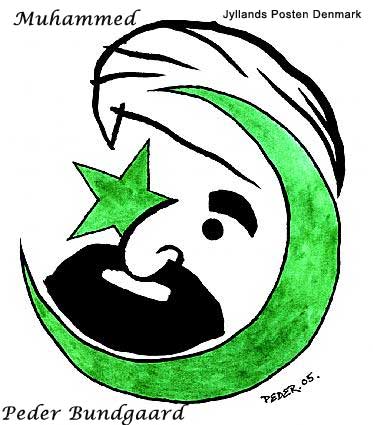
245. Danish Muhammed Cartoons


Last September a Danish newspaper, Jyllands Posten, commissioned and published a series of twelve cartoons depicting various artists' perceptions of Muhammed (and by extension, Islam). That was in the Year of Our Lord 2005 -- notice how even the numbering of years carries a religious significance!! -- and now the editors at Jyllands Posten are starting to wish they hadn't. Not only the newspaper but the whole country of Denmark has become the target of a veritable firestorm of Islamic outrage. Ambassadors have been recalled, trade boycotts have been initiated, and threats of violence have come pouring in.

Two questions. First, why did it take three and a half months for the Islamic world to work itself into its present state of frenzy? Second, what did the editors of the newspaper -- and for that matter, the cartoonists themselves -- expect, given the history of Islamic sensitivity to any real or implied criticism of their religion? Have we so soon forgotten the fatwa on Salman Rushdie, or the assassination of Theo van Gogh in Amsterdam?


The general European reaction across a wide spectrum of government and social opinion has been to deplore the possibility of having truly offended against Islam while stoutly defending the right of freedom of expression as a bulwark of open and free societies. I tend towards the latter view myself (what do you think a Blog is for??) but not to the point where such freedom implies the right to incite hatred or violence towards other groups or individuals. It is interesting in the context of the present virulent attacks on Denmark and the Danish government to note that the same government stepped in quite recently to shut down an anti-Islamic publication on the grounds of incitement. But all that is forgotten in the present excitement.


Is there an anti-Islamic backlash taking root in Europe? It wouldn't altogether surprise me, given the increasing pressures surrounding unintegrated immigration and the intolerable intolerance (to coin a phrase) of Islamic fundamentalists with their openly expressed contempt for Western-style democracy. These chaps don't have to like us or accept our views. We can live with that - well, most Europeans certainly could; I wouldn't be too sure about some of our American cousins, though, wrestling with their own fundamentalist/ideological demons: the 'Rapture' comes to mind, but then so do the neocons and the Project for the New American Century.

On the other hand, we don't have to like them, either, nor do we have to accept their views and interpretations of the world we live in -- a world we have to share, by the way. Can they live with that? Apparently not. There seems to be more than a slight whiff of hypocrisy in the air ...

Here is an interesting Danish blog on the subject.

And in this article Magdi Abelhadi discusses some of the issues which have given rise to the controversy.

And here comes today's coverage onBBC NEWS:

Muhammad cartoon row intensifies

Newspapers across Europe have reprinted caricatures of the Prophet Muhammad to show support for a Danish paper whose cartoons have sparked Muslim outrage.

Seven publications in France, Germany, the Netherlands, Italy and Spain all carried some of the drawings.

Their publication in Denmark led Arab nations to protest. Islamic tradition bans depictions of the Prophet.

The owner of one of the papers to reprint - France Soir - has now sacked its managing editor over the matter.

The cartoons have sparked diplomatic sanctions and death threats in some Arab nations, while media watchdogs have defended publication of the images in the name of press freedom.

Reporters Without Borders said the reaction in the Arab world "betrays a lack of understanding" of press freedom as "an essential accomplishment of democracy."

'Spiting Muslims'

France Soir and Germany's Die Welt were among the leading papers to reprint the cartoons, which first appeared in Denmark last September.

The caricatures include drawings of Muhammad wearing a headdress shaped like a bomb, while another shows him saying that paradise was running short of virgins for suicide bombers.

France Soir originally said it had published the images in full to show "religious dogma" had no place in a secular society.

------------------------------------------------
CARTOON ROW
30 Sept: Danish paper Jyllands-Posten publishes cartoons
20 Oct: Muslim ambassadors in Denmark complain to Danish PM
10 Jan: Norwegian publication reprints cartoons
26 Jan: Saudi Arabia recalls its ambassador
30 Jan: Gunmen raid EU's Gaza office
31 Jan: Danish paper apologises
1 Feb: Papers in France, Germany, Italy and Spain reprint cartoons
------------------------------------------------


But late on Wednesday its owner, Raymond Lakah, said he had removed managing editor Jacques Lefranc "as a powerful sign of respect for the intimate beliefs and convictions of every individual".

Mr Lakah said: "We express our regrets to the Muslim community and all people who were shocked by the publication."

The president of the French Council of the Muslim Faith (CFCM), Dalil Boubakeur, had described France Soir's publication as an act of "real provocation towards the millions of Muslims living in France".

Other papers stood by their publication. In Berlin, Die Welt argued there was a right to blaspheme in the West, and asked whether Islam was capable of coping with satire.

"The protests from Muslims would be taken more seriously if they were less hypocritical," it wrote in an editorial.

La Stampa in Italy, El Periodico in Spain and Dutch paper Volkskrant also carried some of the drawings.

European Muslims spoke out against the pictures.

In Germany, the vice-chairman of the central council of Muslims said Muslims would be deeply offended.

"It was done not to defend freedom of the press, but to spite the Muslims," Mohammad Aman Hobohm said.

Sanctions

Correspondents say the European papers' actions have widened a dispute which has grown very serious for Denmark.

--------------------------------------------------
ART AND BLASPHEMY CHARGES
1989: Iranian spiritual leader Ayatollah Khomeini calls on Muslims to kill British author Salman Rushdie for alleged blasphemy in his book The Satanic Verses
2002: Nigerian journalist Isioma Daniel's article about Prophet and Miss World contestants sparks deadly riots
2004: Dutch film maker Theo van Gogh killed after release of his documentary about violence against Muslim women
2005: London's Tate Britain museum cancels plans to display sculpture by John Latham for fear of offending Muslims after July bombings
--------------------------------------------------

The publication last September in Jyllands-Posten has provoked diplomatic sanctions and threats from Islamic militants across the Muslim world.

Foreign Minister Per Stig Moeller has postponed a trip to Africa because of the dispute.

Thousands of Palestinians protested against Denmark this week, and Arab ministers called on it to punish Jyllands-Posten.

Syria and Saudi Arabia have recalled their ambassadors to Denmark, while Libya said it was closing its embassy in Copenhagen and Iraq summoned the Danish envoy to condemn the cartoons.

The Danish-Swedish dairy giant Arla Foods says its sales in the Middle East have plummeted to zero as a result of the row, which sparked a boycott of Danish products across the region.

The offices of Jyllands-Posten had to be evacuated on Tuesday because of a bomb threat.

The paper had apologised a day earlier for causing offence to Muslims, although it maintained it was legal under Danish law to print them.

Danish Prime Minister Anders Fogh Rasmussen welcomed the paper's apology, but defended the freedom of the press.

Monday, January 30, 2006

244. The River

Brownie, you've done a heck of a job!


The lights from the bridge
on sullen dark waters,
turbidly, sluggishly flowing:
Man, you bad ol' river ....

Come down to Kansas City.
Come down with your St. Louis woman.
Let's just see what you can do.
Me and the boys will be waiting.

When I met you back in Tennessee
You lied when you told me he'd left you.
You lied through your pretty little smiles,
You lied. And once again I believed you.

Here he comes and on sloping shoulders
He carries all the miseries of Missouri:
The failed clothing stores, the sick veterans,
the too many tired and bust-out hopes.

Down around that bend by the hogspit,
That's where we lost young Clare Louise.
She'da bin fifteen last November --
Not a day goes by when I don't recall.

My great-grandaddy Luther LaBeaune
had a pencil moustache, he smoked cheroots.
He wore a tight-fitting flowery weskit,
got shot on the riverboat, aces over threes.

Huck and Jim ain't you no never mind.
Hoo, boy, you never done talk to nigras.
No sirree, you never done talk to them,
in them days you never done SEE them.

Cajun boys they ain't like you and me,
living in little old towns along the bayou.
They eat strange food, they sing strange songs,
when you walk up, goddam, they disappear.

Micks beat up on the wharfside nigras
to get they jobs, been dyin' in the swamps,
and that's what you never hear about Nyawlins,
how the slaves, black and white, they fought each other.

The lights be shining
on sullen dark waters,
sluggishly, turbidly flowing:
Man, you bad ol' river ....

Thursday, January 26, 2006

243. Joe McInerney (1916)

Who fears to speak
Of Easter Week?


Twas late that morning
and I was just coming off
my shift, when suddenly,
who should rise up before me
but young Jimmy Docherty
in crisp unaccustomed
splendour: Jayzus, Jim,
where in the name
of all that's holy
did ye ever come by
that ... that uniform?

All bought and paid for,
says Jim with a grin,
amn't I after paying
two shillin's a week
to the Countess, like.
Ah, the Countess, says I,
would that be yer wan?
O, the very article.
Fierce woman, I'm told.
O, dreadful indeed.
No chance of a look-in?
Haha, laughs Jimmy,
put the thought behind you,
la di feckin da!

Ah, the likes of them, says I,
but what has yourself
abroad, so resplendent,
on this fine Easter Monday?
Tis a parade, says Jimmy,
ourselves and the Volunteers,
a march from Liberty Hall
with a stop at the GPO.
One in the eye to the English,
says I, here in the midst
of their great big war?
God send they lose,
says he with a serious look.
Sure, let them all get kilt,
says I, more power to them,
the less o' them the better.

Is that what you believe,
says Jimmy, half smiling.
Well, and why wouldn't I?
Will you come with me so?
Where to? Around the corner,
a leisurely stroll to the GPO.
Ten minutes will do me no harm,
says I, then it's home to the flat,
to the rashers and sausages.
O Jayz, you're a fearful man
for the feed, says Jimmy.

Is that a real rifle, says I,
or just a bloody good imitation?
O, tis real enough, says he,
with real bullets inside it.
Down with the British Empire!
says I with a happy grin.
Upon which the sun never sets,
answers Jim with a laugh.
For God, we roared out together,
won't trust them in the dark!
Well, tis a fine day for it,
says I ; O, today, says Jim,
is a day that will live forever!
Are ye cracked or what, man,
today will run its course
much the same as any other:
the gentry will go out to the races,
and I’ll go home to me tea,
and we'll wake up tomorrow
under the same oul' Union Jack.

We might, says Jimmy,
and, then again, we might not.
But will ye look over there!
Who in the name of Jayzus,
says I, is that precious article?
Tis Patrick Pearse, says he,
known to himself if none other
as “Padraig O Piarsach” in Irish .
Go ‘way! Aye, the very man,
says he, some half-caste English
sleveen, teaching the Irish nation
how to be even more Irish; sure,
isn’t that the way of them, boyo?
See yer man there, have a gander,
shaking at the knees, suppressing
his Southside accent, reading out
the Proclamation of the Republic!

A peculiar chill came over me,
as slim icy fingers of apprehension
clutched at my heart: Jim, says I,
is this an act, or is it the real M'Coy?
Tis as real as ye like, Joe, says he.
I’ll be leaving ye now, so good luck,
and get yourself home to your tea.
Will ye hang on a sec, Jimmy …!
I watched as he crossed the road:
the windows were being smashed in
and an armed company of soldiers,
Volunteers and Citizen Army,
came to a crashing halt, broke ranks,
and rushed into the building.

I hesitated, sorely puzzled,
then slowly and reluctantly,
started to walk away:
I had gone three steps
when I rushed in after them.

-------------------------------------------
This is a form of dialogue poem based on actual events in Dublin at Easter 1916. Here are some notes and links for the interested:

'the Countess' - Countess Constance Markiewicz, doyenne of the Citizen Army

the GPO - General Post Office, the main Dublin post office on O'Connell Street and HQ of the rebellion.

Liberty Hall - HQ of the main Dublin trade unions.

For general background on the Easter Rising, check the following links:
dublinerinjapan, BBC History, Easter 1916

Finally, a commemorative poem by WB Yeats:

Wednesday, January 11, 2006

242. Seijin Shiki (Coming of Age Ceremony)

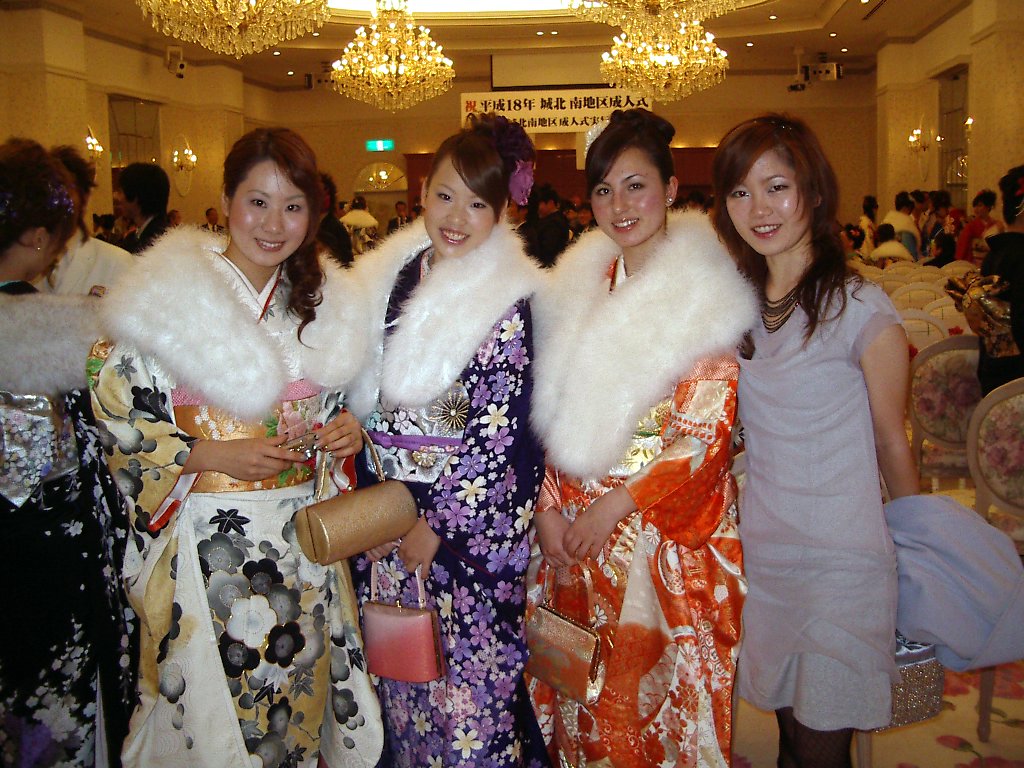
In Japan the young people who will reach their 20th birthday during the course of the year gather for a series of ceremonies on the second Sunday in January funded jointly by the city and their local high schools. It is a public recognition of their adult status. The boys wear formal suits but the girls come out in a gorgeous array of stunningly beautiful kimonos -- as you will see below.

P.S. -- Irish-Japanese is a deadly combination ....


Tuesday, December 13, 2005

239: Denigration of the State: Orhan Pamuk

The novelist Orhan Pamuk is currently being prosecuted under Article 301 of the Turkish Penal Code for daring to raise the question of the historical persecution of Armenians and Kurds. In this recently translated article he expresses his uneasiness with the virulent nationalism of his detractors and the imperfect understanding of his overseas supporters


Orhan Pamuk

My detractors were not motivated just by personal animosity, nor were they expressing hostility to me alone; I already knew that my case was a matter worthy of discussion in both Turkey and the outside world. This was partly because I believed that what stained a country’s “honor” was not the discussion of the black spots in its history but the impossibility of any discussion at all. But it was also because I believed that in today’s Turkey the prohibition against discussing the Ottoman Armenians was a prohibition against freedom of expression, and that the two matters were inextricably linked. Comforted as I was by the interest in my predicament and by the generous gestures of support, there were also times when I felt uneasy about finding myself caught between my country and the rest of the world.

The hardest thing was to explain why a country officially committed to entry in the European Union would wish to imprison an author whose books were well known in Europe, and why it felt compelled to play out this drama (as Conrad might have said) “under Western eyes.” This paradox cannot be explained away as simple ignorance, jealousy, or intolerance, and it is not the only paradox. What am I to make of a country that insists that the Turks, unlike their Western neighbors, are a compassionate people, incapable of genocide, while nationalist political groups are pelting me with death threats? What is the logic behind a state that complains that its enemies spread false reports about the Ottoman legacy all over the globe while it prosecutes and imprisons one writer after another, thus propagating the image of the Terrible Turk worldwide? When I think of the professor whom the state asked to give his ideas on Turkey’s minorities, and who, having produced a report that failed to please, was prosecuted, or the news that between the time I began this essay and embarked on the sentence you are now reading five more writers and journalists were charged under Article 301, I imagine that Flaubert and Nerval, the two godfathers of Orientalism, would call these incidents bizarreries, and rightly so.

That said, the drama we see unfolding is not, I think, a grotesque and inscrutable drama peculiar to Turkey; rather, it is an expression of a new global phenomenon that we are only just coming to acknowledge and that we must now begin, however slowly, to address. In recent years, we have witnessed the astounding economic rise of India and China, and in both these countries we have also seen the rapid expansion of the middle class, though I do not think we shall truly understand the people who have been part of this transformation until we have seen their private lives reflected in novels. Whatever you call these new élites—the non-Western bourgeoisie or the enriched bureaucracy—they, like the Westernizing élites in my own country, feel compelled to follow two separate and seemingly incompatible lines of action in order to legitimatize their newly acquired wealth and power. First, they must justify the rapid rise in their fortunes by assuming the idiom and the attitudes of the West; having created a demand for such knowledge, they then take it upon themselves to tutor their countrymen. When the people berate them for ignoring tradition, they respond by brandishing a virulent and intolerant nationalism. The disputes that a Flaubert-like outside observer might call bizarreries may simply be the clashes between these political and economic programs and the cultural aspirations they engender. On the one hand, there is the rush to join the global economy; on the other, the angry nationalism that sees true democracy and freedom of thought as Western inventions.

V. S. Naipaul was one of the first writers to describe the private lives of the ruthless, murderous non-Western ruling élites of the post-colonial era. Last May, in Korea, when I met the great Japanese writer Kenzaburo Oe, I heard that he, too, had been attacked by nationalist extremists after stating that the ugly crimes committed by his country’s armies during the invasions of Korea and China should be openly discussed in Tokyo. The intolerance shown by the Russian state toward the Chechens and other minorities and civil-rights groups, the attacks on freedom of expression by Hindu nationalists in India, and China’s discreet ethnic cleansing of the Uighurs—all are nourished by the same contradictions.

As tomorrow’s novelists prepare to narrate the private lives of the new élites, they are no doubt expecting the West to criticize the limits that their states place on freedom of expression. But these days the lies about the war in Iraq and the reports of secret C.I.A. prisons have so damaged the West’s credibility in Turkey and in other nations that it is more and more difficult for people like me to make the case for true Western democracy in my part of the world.

(Translated, from the Turkish, by Maureen Freely.)

-- the article can be read in full at 'The New Yorker'

Saturday, December 10, 2005

238. Art, Truth and Politics

Having just been awarded the 2005 Nobel Prize for Literature, the ailing British playwright Harold Pinter unleashed a devastating attack on US foreign policy in a video-taped speech of acceptance. Lengthy extracts from the speech follow below. To access the complete text click here.


In 1958 I wrote the following:

"There are no hard distinctions between what is real and what is unreal, nor between what is true and what is false. A thing is not necessarily either true or false; it can be both true and false."

I believe that these assertions still make sense and do still apply to the exploration of reality through art. So as a writer I stand by them but as a citizen I cannot. As a citizen I must ask: What is true? What is false?

Truth in drama is forever elusive. You never quite find it but the search for it is compulsive. The search is clearly what drives the endeavour. The search is your task. More often than not you stumble upon the truth in the dark, colliding with it or just glimpsing an image or a shape which seems to correspond to the truth, often without realising that you have done so. But the real truth is that there never is any such thing as one truth to be found in dramatic art. There are many. These truths challenge each other, recoil from each other, reflect each other, ignore each other, tease each other, are blind to each other. Sometimes you feel you have the truth of a moment in your hand, then it slips through your fingers and is lost.

I have often been asked how my plays come about. I cannot say. Nor can I ever sum up my plays, except to say that this is what happened. That is what they said. That is what they did.

(He explains how he writes his plays and gives several examples)

Political language, as used by politicians, does not venture into any of this territory since the majority of politicians, on the evidence available to us, are interested not in truth but in power and in the maintenance of that power. To maintain that power it is essential that people remain in ignorance, that they live in ignorance of the truth, even the truth of their own lives. What surrounds us therefore is a vast tapestry of lies, upon which we feed.

As every single person here knows, the justification for the invasion of Iraq was that Saddam Hussein possessed a highly dangerous body of weapons of mass destruction, some of which could be fired in forty-five minutes, bringing about appalling devastation. We were assured that was true. It was not true. We were told that Iraq had a relationship with Al Quaeda and shared responsibility for the atrocity in New York of September 11, 2001. We were assured that this was true. It was not true. We were told that Iraq threatened the security of the world. We were assured it was true. It was not true.

The truth is something entirely different. The truth is to do with how the United States understands its role in the world and how it chooses to embody it.

But before I come back to the present I would like to look at the recent past, by which I mean United States foreign policy since the end of the Second World War. I believe it is obligatory upon us to subject this period to at least some kind of even limited scrutiny, which is all that time will allow here.

Everyone knows what happened in the Soviet Union and throughout Eastern Europe during the post-war period: the systematic brutality, the widespread atrocities, the ruthless suppression of independent thought. All this has been fully documented and verified.

But my contention here is that the US crimes in the same period have only been superficially recorded, let alone documented, let alone acknowledged, let alone recognised as crimes at all. I believe this must be addressed and that the truth has considerable bearing on where the world stands now. Although constrained, to a certain extent, by the existence of the Soviet Union, the United States' actions throughout the world made it clear that it had concluded it had carte blanche to do what it liked.

Direct invasion of a sovereign state has never in fact been America's favoured method. In the main, it has preferred what it has described as "low intensity conflict." Low intensity conflict means that thousands of people die but slower than if you dropped a bomb on them in one fell swoop. It means that you infect the heart of the country, that you establish a malignant growth and watch the gangrene bloom. When the populace has been subdued--or beaten to death, the same thing--and your own friends, the military and the great corporations, sit comfortably in power, you go before the camera and say that democracy has prevailed. This was a commonplace in US foreign policy in the years to which I refer.

(He goes on to discuss the situation in Nicaragua during the 1980s in some detail, including a meeting at the US Embassy in London at which he was present).

The United States supported and in many cases engendered every right wing military dictatorship in the world after the end of the Second World War. I refer to Indonesia, Greece, Uruguay, Brazil, Paraguay, Haiti, Turkey, the Philippines, Guatemala, El Salvador, and, of course, Chile. The horror the United States inflicted upon Chile in 1973 can never be purged and can never be forgiven.

Hundreds of thousands of deaths took place throughout these countries. Did they take place? And are they in all cases attributable to US foreign policy? The answer is yes they did take place and they are attributable to American foreign policy. But you wouldn't know it.

It never happened. Nothing ever happened. Even while it was happening it wasn't happening. It didn't matter. It was of no interest. The crimes of the United States have been systematic, constant, vicious, remorseless, but very few people have actually talked about them. You have to hand it to America. It has exercised a quite clinical manipulation of power worldwide while masquerading as a force for universal good. It's a brilliant, even witty, highly successful act of hypnosis.

I put to you that the United States is without doubt the greatest show on the road. Brutal, indifferent, scornful and ruthless it may be but it is also very clever. As a salesman it is out on its own and its most saleable commodity is self love. It's a winner. Listen to all American Presidents on television say the words, "the American people," as in the sentence, "I say to the American people it is time to pray and to defend the rights of the American people and I ask the American people to trust their President in the action he is about to take on behalf of the American people."

It's a scintillating stratagem. Language is actually employed to keep thought at bay. The words "the American people" provide a truly voluptuous cushion of reassurance. You don't need to think. Just lie back on the cushion. The cushion may be suffocating your intelligence and your critical faculties but it's very comfortable. This does not apply of course to the 40 million people living below the poverty line and the 2 million men and women imprisoned in the vast gulag of prisons, which extends across the US.

The United States no longer bothers about low intensity conflict. It no longer sees any point in being reticent or even devious. It puts its cards on the table without fear or favour. It quite simply doesn't give a damn about the United Nations, international law or critical dissent, which it regards as impotent and irrelevant. It also has its own bleating little lamb tagging behind it on a lead, the pathetic and supine Great Britain.

What has happened to our moral sensibility? Did we ever have any? What do these words mean? Do they refer to a term very rarely employed these days - conscience? A conscience to do not only with our own acts but to do with our shared responsibility in the acts of others? Is all this dead? Look at Guántanamo Bay. Hundreds of people detained without charge for over three years, with no legal representation or due process, technically detained forever. This totally illegitimate structure is maintained in defiance of the Geneva Convention. It is not only tolerated but hardly thought about by what's called the "international community." This criminal outrage is being committed by a country, which declares itself to be "the leader of the free world."

Do we think about the inhabitants of Guántanamo Bay? What does the media say about them? They pop up occasionally--a small item on page six. They have been consigned to a no man's land from which indeed they may never return. At present many are on hunger strike, being force-fed, including British residents. No niceties in these force-feeding procedures. No sedative or anaesthetic. Just a tube stuck up your nose and into your throat. You vomit blood. This is torture. What has the British Foreign Secretary said about this? Nothing. What has the British Prime Minister said about this? Nothing. Why not? Because the United States has said: To criticize our conduct in Guantánamo Bay constitutes an unfriendly act. You're either with us or against us. So Blair shuts up.

The invasion of Iraq was a bandit act, an act of blatant state terrorism, demonstrating absolute contempt for the concept of international law. The invasion was an arbitrary military action inspired by a series of lies upon lies and gross manipulation of the media and therefore of the public; an act intended to consolidate American military and economic control of the Middle East masquerading--as a last resort, all other justifications having failed to justify themselves--as liberation. A formidable assertion of military force responsible for the death and mutilation of thousands and thousands of innocent people.

We have brought torture, cluster bombs, depleted uranium, innumerable acts of random murder, misery, degradation and death to the Iraqi people and call it "bringing freedom and democracy to the Middle East."

How many people do you have to kill before you qualify to be described as a mass murderer and a war criminal? One hundred thousand? More than enough, I would have thought. Therefore it is just that Bush and Blair be arraigned before the International Criminal Court of Justice. But Bush has been clever. He has not ratified the International Criminal Court of Justice. Therefore if any American soldier or for that matter politician finds himself in the dock Bush has warned that he will send in the marines. But Tony Blair has ratified the Court and is therefore available for prosecution. We can let the Court have his address if they're interested. It is Number 10, Downing Street, London.

Death in this context is irrelevant. Both Bush and Blair place death well away on the back burner. At least 100,000 Iraqis were killed by American bombs and missiles before the Iraq insurgency began. These people are of no moment. Their deaths don't exist. They are blank. They are not even recorded as being dead. "We don't do body counts," said the American general Tommy Franks.

Early in the invasion there was a photograph published on the front page of British newspapers of Tony Blair kissing the cheek of a little Iraqi boy. "A grateful child," said the caption. A few days later there was a story and photograph, on an inside page, of another 4-year-old boy with no arms. His family had been blown up by a missile. He was the only survivor. '"When do I get my arms back?" he asked. The story was dropped. Well, Tony Blair wasn't holding him in his arms, nor the body of any other mutilated child, nor the body of any bloody corpse. Blood is dirty. It dirties your shirt and tie when you're making a sincere speech on television.

The 2,000 American dead are an embarrassment. They are transported to their graves in the dark. Funerals are unobtrusive, out of harm's way. The mutilated rot in their beds, some for the rest of their lives. So the dead and the mutilated both rot, in different kinds of graves.

(He quotes a poem of Pablo Neruda as a "Powerful visceral description of the bombing of civilians").

I have said earlier that the United States is now totally frank about putting its cards on the table. That is the case. Its official declared policy is now defined as "full spectrum dominance." That is not my term, it is theirs. "Full spectrum dominance" means control of land, sea, air and space and all attendant resources.

The United States now occupies 702 military installations throughout the world in 132 countries, with the honourable exception of Sweden, of course. We don't quite know how they got there but they are there all right.

The United States possesses 8,000 active and operational nuclear warheads. Two thousand are on hair trigger alert, ready to be launched with fifteen minutes warning. It is developing new systems of nuclear force, known as bunker busters. The British, ever cooperative, are intending to replace their own nuclear missile, Trident. Who, I wonder, are they aiming at? Osama bin Laden? You? Me? Joe Dokes? China? Paris? Who knows? What we do know is that this infantile insanity--the possession and threatened use of nuclear weapons--is at the heart of present American political philosophy. We must remind ourselves that the United States is on a permanent military footing and shows no sign of relaxing it.

Many thousands, if not millions, of people in the United States itself are demonstrably sickened, shamed and angered by their government's actions, but as things stand they are not a coherent political force-- yet. But the anxiety, uncertainty and fear which we can see growing daily in the United States is unlikely to diminish.

I know that President Bush has many extremely competent speech writers but I would like to volunteer for the job myself. I propose the following short address which he can make on television to the nation. I see him grave, hair carefully combed, serious, winning, sincere, often beguiling, sometimes employing a wry smile, curiously attractive, a man's man.

"God is good. God is great. God is good. My God is good. Bin Laden's God is bad. His is a bad God. Saddam's God was bad, except he didn't have one. He was a barbarian. We are not barbarians. We don't chop people's heads off. We believe in freedom. So does God. I am not a barbarian. I am the democratically elected leader of a freedom-loving democracy. We are a compassionate society. We give compassionate electrocution and compassionate lethal injection. We are a great nation. I am not a dictator. He is. I am not a barbarian. He is. And he is. They all are. I possess moral authority. You see this fist? This is my moral authority. And don't you forget it."

A writer's life is a highly vulnerable, almost naked activity. We don't have to weep about that. The writer makes his choice and is stuck with it. But it is true to say that you are open to all the winds, some of them icy indeed. You are out on your own, out on a limb. You find no shelter, no protection--unless you lie--in which case of course you have constructed your own protection and, it could be argued, become a politician.

(He quotes a poem of his own called 'Death').

When we look into a mirror we think the image that confronts us is accurate. But move a millimetre and the image changes. We are actually looking at a never-ending range of reflections. But sometimes a writer has to smash the mirror--for it is on the other side of that mirror that the truth stares at us.

I believe that despite the enormous odds which exist, unflinching, unswerving, fierce intellectual determination, as citizens, to define the real truth of our lives and our societies is a crucial obligation which devolves upon us all. It is in fact mandatory.

If such a determination is not embodied in our political vision we have no hope of restoring what is so nearly lost to us--the dignity of man.

___

Thursday, December 08, 2005

127. Pearl Harbour - 64 Years On


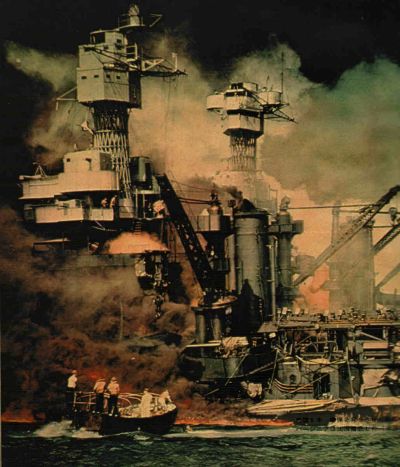
Battleship Row under attack Posted by Hello

This attack was the 9/11 of our grandparents' generation - it came as just as much a shock to an inward-looking America in 1941 as the attack on the Twin Towers and the Pentagon was to do sixty years later.

The main difference between the two events was that the attack on Pearl Harbour was an act of war by a hostile sovereign state, whereas the 9/11 attack was the brainchild of a shadowy group of international Islamist ideologues. Afghanistan and then Iraq took the brunt of America's outraged response to 9/11, although it would seem that the real perpetrators of the airliner assaults were citizens of Saudi Arabia, Egypt and Jordan.

Osama bin Laden, the leader of the Islamist Al Quaida group and one of the presumed planners of the attack, had taken refuge with the Taliban in Afghanistan. This helps to explain why America decided to attack that country, but it does not clarify why the Bush administration turned its attention to Iraq before the campaign in Afghanistan was completed and before bin Laden was apprehended. He is still at large. He sends out provocative videos and audio tapes from time to time, and this enhances his stature as a rebel hero among young and gullible elements in the Arabic and wider Muslim world: in this way he is actually winning the propaganda war in the Middle East and South Central Asia.


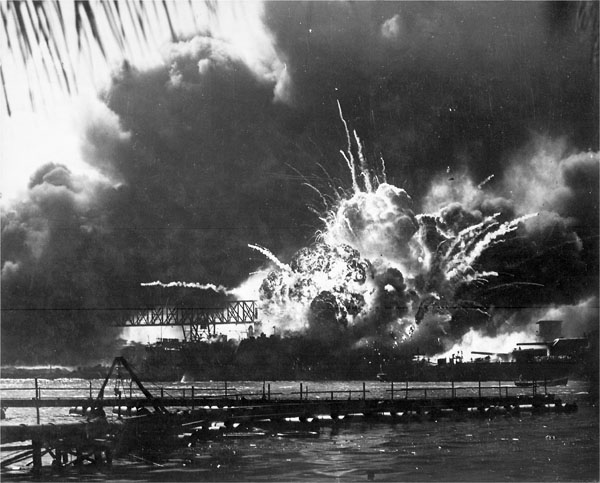
USS Shaw explodes Posted by Hello

In December 1941, however, the enemy was clearly identified as the government of Japan and America declared war on that country without delay. Nazi Germany obliged President Roosevelt by declaring war on America (as did Mussolini's Italy) shortly afterward, thus solving Roosevelt's problem of how to involve his reluctant and previously isolationist countrymen in the war against the Axis Powers in Europe. In fact, most US resources were directed toward the war in Europe; until late 1944 the war against Japan was largely conducted by the Navy and Marine Corps.


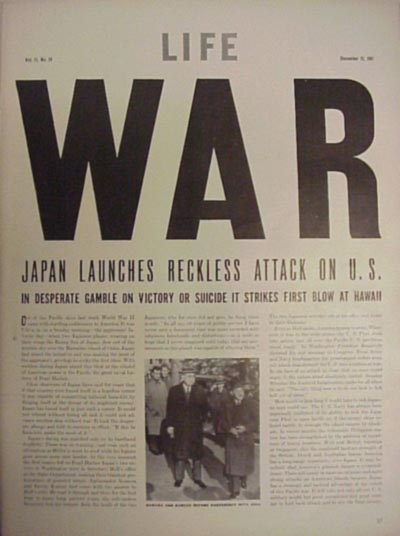
Life Magazine - 15 Dec 1941 Posted by Hello

The attack on Pearl Harbour was a brilliant tactical success for the Japanese - even though they missed the aircraft carriers which happened to be out at sea - since it effectively knocked the US Navy out of the Pacific for a period of about six months. Having secured nearly total surprise,their losses in planes and pilots were negligible. At the same time, and rather typical of Japanese military thinking, the detailed tactical planning was faultless but the overall strategic concept was based on false assumptions about America, a terrible blunder, in fact, which was to lead to the near-destruction of the Japanese home islands and the devastation of Hiroshima and Nagasaki.


Japanese Combined Fleet Staff (Admiral Yamamoto is 2nd from left) Posted by Hello

Why did they do it? What did they hope to accomplish by rousing the sleeping giant of the United States?

The view from Japan

Every country has a tendency to view the rest of the world through the prism of its own self-image (tainted history) and self-interest. Japan in the 1930s was a particularly self-absorbed and intensely patriotic society bent on extending its reach overseas to create a Greater Japanese Empire following the model of the 19th century European powers, but this at a time when the idea of empire had lost any former support in the home countries and had passed into rapid decline, particularly in the aftermath of the First World War. Japan had come late to the game of industrial power and military might, but it was eager to catch up with a world which had moved on in the meantime.

Since the 1870s Japan had transformed itself from an exotic feudal backwater to become the leading military and industrial power in Asia. It had waged successful wars against China and Russia and had annexed, along the way, both Taiwan and Korea. Its armies had recently taken over Manchuria which it was busily exploiting for its natural resources. Japan was eager to assert its newly created power, no matter how late it had come to the imperial table.

Creating an empire at the expense of its neighbours went deeper than a simple display of national pride and martial vigour. Japan held a population in excess of 100 million in a narrow, mountainous, archipelago smaller in area than the state of California. It had no natural resources to speak of and its fledgling export market had been cruelly hit by the Great Depression. The political unrest which brought the militarists to power in the mid-1930s had in part been driven by appalling conditions of near starvation in the countryside (from which the Army drew most of its recruits).

Japan was hungry for land, fuel and resources - first in Manchuria and then in China, which it attacked in 1937. The war in China went well at first with Japanese forces seizing Shanghai and all of the Chinese coastal provinces. It was only when the Army moved inland that the vastness of the land engulfed them. They had superior firepower, better equipment, air support, and well-trained troops: they never actually lost any battle or failed in any siege of a city (Nanking is one telling example) but they were unable to secure the lands they overran and came under constant attack from both the Communists under Mao-tse-tung and the American-backed Nationalists (Kuomintang) under Chiang-kai-shek. (More of the former than of the latter, it should be remarked). Casualties mounted on the Japanese side -- the Chinese suffered far worse -- and the war became increasingly brutal.

To Be Continued ... if time permits. December is always a crazily busy month!

Sunday, December 04, 2005

237. A Reminder

Have you ever noticed
how nation-states
and empires in particular
politicize everyday
life, mess with your head?

Believe this, don't
believe that; listen
to what we say; don't
dare investigate
our slimy secrets?

A filthy dictatorship
is good for your soul
because
evil in black and white
rouses
decent people
to righteous resistance.

You know where you stand.

At home, among friends,
in the half light
and the hypocricy,
amid the general confusion
and a childish wish to believe
in Santa, measured
against moderate
disapproval of extremes,
the sleepless
ambitious manipulators
find the room to play
with our illusions,
our good faith,
our laziness,
and so insist
we support them,
even collaborate
in their will to power,
their urge to kill.

War is always
a bad sign: outer-directed
violence soon redirects
upon the home population:
keep a weather eye
on the process of detention
(habeas corpus!!)
as the hardwon rights
of several centuries
melt away
in spite of your careless
sense of safety.

Nobody is safe.

You won't be flying today, ma'am.
Excuse me? Why not?
I'm not allowed to tell you.

Sooner or later
we can anticipate
prosecution
for political opposition,
perhaps even
spine-tingling
judicial executions.

Never, never happen here!!!!!
Don't be stupid.
Check out the real history
of so-called
"national emergencies"
starting with
The Civil War.

The government
doesn't need a legal basis
to come after you.
It will when it wants to.

The Molly Maguires,
the Spanish-American war,
the Wobblies (International Workers of the World),
Eugene Debs,
the First World War,
the Red Scare of 1919,
World War Two,
the McCarthy hearings,
Vietnam,
Daniel Ellsberg,
and now ....
direct from Washington
brought to your own living room --
The Global (boom)
War (boom)
on Terror!!! (cymbals, boom).

Here we go
Here we go
(again).

Saturday, December 03, 2005

236. EFL (English as a Foreign Language)

This gap-toothed
grinning baboon
runs a chain of schools
and sucks in
two million
dollars
each year
out of which
he seems to be willing
to pay me
2000 bucks a month
(before deductions)
if I meet
his rather
hard-to-fathom
requirements.
Mister Bobby, he says,
but my friends
just call me Bob
(and you can call me Robert).
No, no, Mister Bobby,
nice and fliendly, students like,
I like, his gold teeth
gleam, a wide smile
dazzles but never reaches
his flat
blackcurrant eyes.
We have many girl
so we need handsome boy,
tall, blue eye, you know?
As I said, Mister Sato,
I have a Master's degree
in English, seven years
of experience
teaching EFL
in Spain, Russia
and Saudi Arabia.
Oh -- ho ho ho ho ho !
Very good, very good,
you never date girls, OK?
Excuse me?
You teach, no touch,
no go outside, OK?
You mean my students?
Hai, hai, hai!!
Girl maybe like you, come school,
but you nevah nevah nevah
OK?
For businessmens
we have
blonde American ladies
with big, haha,
(he juggles his chest)
but no touch, no see
outside, same
like you, OK?
I begin
to understand
the intellectual
level
of this business.
You no join union
(a spit and a hiss)
you give me also
your passport
I take care
everything.
No Ploblem.
Big smile.
Sweaty handshake.
I need a job.
I'm broke.
I'm in debt to the guys
who have let me crash
in their tiny Tokyo apartment.
I must get a job,
I must get a job
but hang on ....
wait a second!

Wednesday, November 30, 2005

235. Heaven Sent


God heard the embattled nations sing and shout
'Gott strafe England!' and 'God save the King!'
God this, God that, and God the other thing —
'Good God!' said God, 'I've got my work cut out!'

Does God endorse George Bush?

So, does God endorse our own George Bush?
Emmm ... says God ... George Who?

I'm more interested
in the poor
the downtrodden
the ill, the suffering,
the starving children,
the victims of injustice,
the suffering souls
whose hearts
are still open to divine love.
These are the inheritors
of the Kingdom of Heaven ...

and there's not much room
for the fat and the sassy.

We have adopted
a restricted entry program
for the French
and Americans
Democrats and Republicans alike
(same difference)
and
we are having
slightly increasing success
in keeping out the Irish
while
maintaining strict limits
on the English
and the Welsh
but we rather like the Geordies
who follow the Toon
and the Kilties
who support Celtic
whereas
Chelsea luvvies
are
immediately transported
to
The Other Establishment.

So there you are, says God.

OK, right ... here comes the article.

Does God endorse George Bush?
By Steven Waldman
-extracts-

(While) Bush's public comments about faith have been mostly within the mainstream tradition of presidential rhetoric, his supporters lately have gone in a less-familiar direction: conveying the idea that God is responsible for Bush being in the White House.

"He is one of those men God and fate somehow lead to the fore in times of challenge," said George Pataki in the high-profile introduction of Bush at the Republican National Convention, an introduction almost certainly scrubbed if not written by the White House.

"I thank God that on September 11th, we had a president who didn't wring his hands and wonder what America had done wrong to deserve this attack," he added. "I thank God we had a president who understood that America was attacked, not for what we had done wrong, but for what we did right."

If he'd said "thank God" just once we might have concluded this was simply colloquial usage—a dramatic way of saying, "it's a darn good thing." That the man introducing Bush thanked God three times makes it suspicious, even more so given these lines from Rudy Giuliani's speech two nights earlier: "Spontaneously, I grabbed the arm of then Police Commissioner Bernard Kerik and said to Bernie, 'Thank God, George Bush is our president.' " And, to reinforce the point, Giuliani added, "And I say it again tonight: Thank God, George Bush is our president."

This is not the first time it's been suggested that God deserves thanks for the 2000 election results. Several sympathetic books about Bush and his faith make a big deal of his deciding to run for president after hearing a Texas minister named Rev. Mark Craig preach about how Moses had been called to service by God. Bush's mother reportedly turned to her son after the sermon and said, "He was talking to you."

Stephen Mansfield, author of The Faith of George W. Bush, goes on to say: "Not long after, Bush called James Robison (a prominent minister) and told him, 'I've heard the call. I believe God wants me to run for President.' " Richard Land of the Southern Baptist Convention heard Bush say something similar: "Among the things he said to us was: I believe that God wants me to be president, but if that doesn't happen, it's OK.' "

After 9/11, the sense among his supporters that God had chosen him increased. "I think that God picked the right man at the right time for the right purpose," said popular Christian broadcaster Janet Parshall. Gen. William "Jerry" Boykin, who got in trouble for derogatory comments about Islam, argued that it must have been God who selected Bush, since a plurality of voters hadn't. "Why is this man in the White House? The majority of America did not vote for him. He's in the White House because God put him there for a time such as this." (Boykin still has his job.)

Time magazine reported, "Privately, Bush talked of being chosen by the grace of God to lead at that moment." World Magazine, a conservative Christian publication, quoted White House official Tim Goeglein as saying, "I think President Bush is God's man at this hour, and I say this with a great sense of humility."

Even former President George H.W. Bush speculated that perhaps he needed to be defeated so that his son could become president: "If I'd won that election in 1992, my oldest son would not be president of the United States of America," he said. "I think the Lord works in mysterious ways."

Are the White House and the Bush campaign actively encouraging the idea that Bush has been put there by God? Bush has been careful to never say anything close to that in public. And yet the combination of passages in carefully vetted speeches and quotes from close friends or supporters indicate that this is the understanding.

In one sense, it's not surprising that some people believe this. Many, if not most, Americans believe that God intervenes in the lives of humans. If that weren't the case, prayer might be considered superfluous, meaningless. If God intervenes in the affairs of ordinary humans who pray for recovery from illness or a better job, it only stands to reason that He would control something as consequential as an American presidency.

Saturday, November 19, 2005

234. Uncivil War


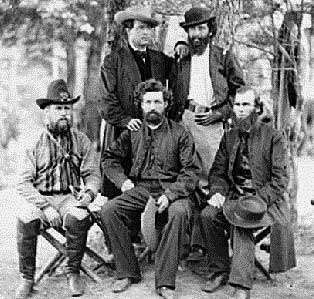
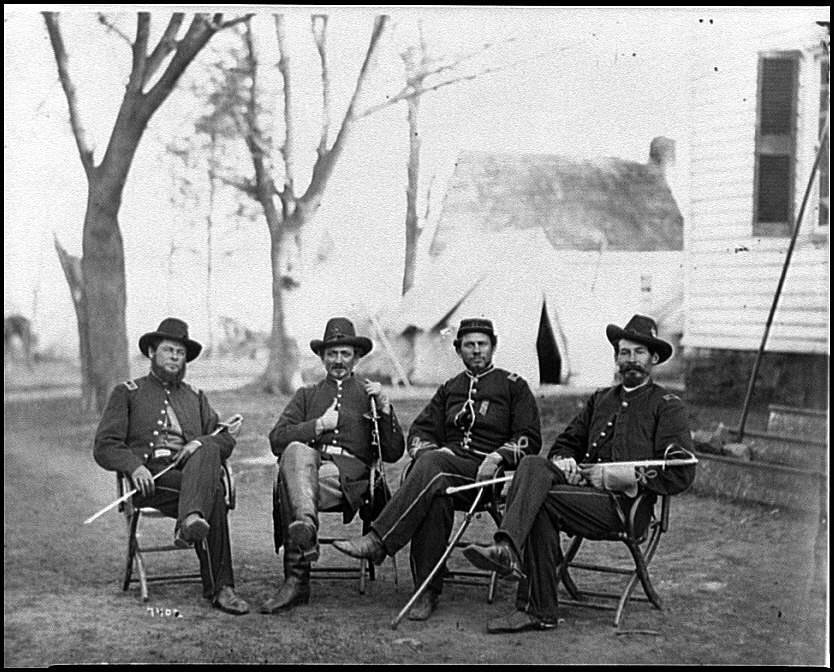
A Matthew Brady portrait of Union officers, ca.1862

Fredericksburg.
Chancellorsville.

Massa Robert was on a roll.
His army was invincible
and, yes, by God they knew it!
Time to cross the Potomac.

Lee's Union opponent, Hooker,
was badly confused,
at odds with the War Department
at odds with Honest Abe.

Time to cross the river.

Maryland, Pennsylvania,
untouched peaceful farms,
milk, butter, eggs and beef:
live off their land for a change

(but all paid for in Southern script).

Meanwhile
down in Richmond
capital of the CSA
sits wild and beloved Johnny Mitchel.

Who is this man?

Mitchel was England's
worst nightmare, a revolutionary
in control of a Dublin newspaper,
calling for the end of English rule.

Get your fat British behinds
out of Ireland, today and
not tomorrow: this was
the tone and import of the "United Irishman"

The English, as is their wont,
passed a brand new law
ex post facto, a frequent occurrence,
to nail this firebrand nuisance.

................................................................. John Mitchel (1815-1875

So, for his sins, poor John
and Francy Meagher, his friend,
were sentenced to death for treason
but transported to Australia instead.

Out of sight, out of mind.

From Australia they both escaped
(conspiracy theories abound)
and both, separately, made their way
to the USA, safe among Irish friends.

John sailed back to France
(Ireland was unsafe, but France was free)
while Meagher took over the Irish in New York.
Then along came the Civil War.

Francy took command of the Fighting 69th
the best and the worst of the New York Irish
committed to the Union cause.
But Mitchel came out for the South.

Returned to Richmond (running the blockade)
his sons joined Confederate regiments
while Mitchel himself wrote intemperate articles
for the local newspapers.

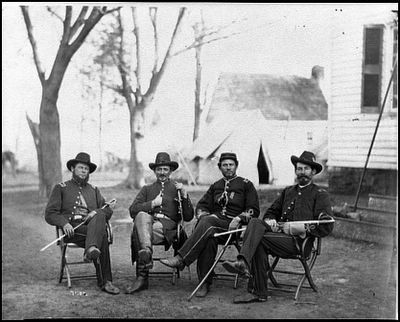
.................................TF Meagher (seated, centre) with officers of the Fighting 69th

Now Lee crosses the Potomac.

Among the troops under his command
are the veteran First Virginians
with their standard bearer, young Willie,
17-year-old son of John Mitchel.


Hooker gets the push and in comes Meade
(Union generals never lasted long).
The armies march under the summer sun
and make contact in rural Pennsylvania.

Gettysburg.

Two days of deadly skirmishing:
marches, countermarches,
concentrated cannonades,
savage assaults, grim defences,
until both armies, Union and Confederate,
like bareknuckle boxers
bloodied and exhausted,
stagger, punch drunk, to the mark
and face the third and final day:

July 3, 1863.

Not only the battle
but the outcome of the War
hangs in the balance.

------------------------------------------
Intense fighting erupted on Culp's Hill at 4 AM on July 3 and by 11 AM Union troops had secured the hill, firmly anchoring the point of the Union 'fishhook' line. With the loss of his advantage at Culp's Hill, Lee decided to alter his strategy. Lee decided to strike what he thought to be a weakened Union center on Cemetery Ridge where he observed few troops and only a handful of artillery batteries. If this section of Meade's line collapsed, it would threaten the Union rear. Lee issued orders for a massive bombardment followed by an assault of 18,000 men, commanded by General James Longstreet. Longstreet's Assault, better known today as "Pickett's Charge" would be Lee's last gamble at Gettysburg.
http:// www.nps.gov/gett/gettour/day3.htm *
-------------------------------------------

Waiting for orders --
then abruptly hauled into the line
along with so many others
come the First Virginians:
and among them Willie Mitchel.

Wait for it ...
Wait for it ...
Then the air splits with the sound
of high-pitched bugles:
now, boys, now,
now, now, now!
The screaming 'caoine' of the Rebel Yell:
Charge!!

The bullets come sizzling by
whizzing like demented hornets
zzzzzzzzz... then a dull flat 'pok'
when they hit with a puff of dust
and down goes the sergeant
down goes Billy Joe Parker
down goes the Preacher
then red-haired Randy Simmonds
Archie Drummond, poor little
Jimmy Preston, then that bald
old bastard what's-his-name,
then Johnny Belham, Andrew Holland,
"Daddy" Goulder, Snakepit Jones,
Paddy Miles, Dandy Kelleher,
'Arsey' Versey, Jimbo, Davy, Mack,
Pauly O'Brien ... Pascal ... all of them?
"Get your ass up here, Mitchel,
and take this goddam flag!!"
He stumbles, drop his rifle,
hears a sizzling past his ear
and grabs the blood-smeared
wooden pole, the flag little more
than a rag shot through
with holes and he runs
and he runs and he runs
and he ....

Down past Coliso Farm
in the grey morning dawn
come O'Rourke and Timothy Fallon
gaunt-visaged figures in Union blue
with Privates O'Donnell and McCarthy
and with the two corporals
Delaroche and McInteer
to recover the body
of John Mitchel's son.
They carry him away from the field
in a final act of honour
and respect for his patriot father;
the blood-sodden war, for the moment
forgotten, and the next war,
the long hard struggle for Ireland
very much in mind.
-------------------------------------------------
* -- for some obscure reason the National Park Service will not always accept a linked post and will flash a Security Violation message: if this happens to you simply copy/paste the URL into a new browser window: http:// www.nps.gov/gett/gettour/day3.htm
-------------------------------------------------
First off, this piece says more about Ireland than the American Civil War. Sorry. But people fight in wars (even your own) for different reasons ....

John Mitchel was imprisoned after the Civil War for his unapologetic support of the Confederacy but he managed to make his way back to Ireland where he was elected to the British Parliament in 1874. He refused to take his seat (as elected Sinn Fein candidates in British-controlled Northern Ireland continue to do today) because he would not take an oath of loyalty to the British Crown. The British annulled the election on the grounds that Mitchel was a convicted felon but he won re-election with an even larger majority. Do not mess with the Irish. He died before the Brits could decide what to do next. In the aftermath of the Civil War many ex-soldiers (Confederate and Union alike) took part in the Fenian Rising of 1867 which was brutally suppressed by the British. Jail sentences for the survivors were savage. Out of these hellish prisons came Tom Clarke who helped to set up the Irish Republican Brotherhood (IRB) in Dublin in the decades before the First World War. On the principle that England's misfortune was Ireland's opportunity the rebels struck during Easter Week of 1916. The rebellion was suppressed and the leaders (including Clarke) summarily executed. But after the Crucifixion came the Resurrection and the modern Irish republic was born out of the anger and disgust with Britain that became a national movement for independence after the events of 1916. Thank You and God Bless You, Michael Collins. I mean that. Without you I'd still be waltzing around the world with a British passport.

--------------------------------------------

In-house Links:

history The Runup to Easter 1916

poem After the Rising

tongue-in-cheek history primer for beginners From the Normans to Michael Collins (1170-1922)

poem Across the Water

history (anger, regret) Armistice Day

Saturday, November 12, 2005

233. Totally Brilliant

You're going to need QuickTime 6+ for this and probably a broadband or LAN connection. The URLs will not work as links (you have to copy/paste into a new browser window) and they might take a minute or two to load ... but as the Guinness people are forever telling us, it's definitely worth the hassle and the wait!

speaking of which, My Goodness My Guinness http://www.bestadsontv.com/ad_details.php?id=634


Hang the expense - go for a Stella! http://www.bestadsontv.com/ad_details.php?id=151


Singin in the Rain -- with my Volkswagen. http://www.bestadsontv.com/ad_details.php?id=25


so very very sad - a Heineken moment. http://www.bestadsontv.com/ad_details.php?id=32

Wednesday, November 09, 2005

232. Birthday Poem
I don't even want
to think
about
all the things
that
have happened;
nor think
about
all the things
that
mercifully
didn't.

I deal
most of the time
with the
surrounding world
in English
except
when I don't:
that's when
two other
languages
come into play
and spatterings
of six or seven
others.

This
creates an
uncalibrated
form
of cultural calculus
in which
the fixed
point
(from which perspective
either reveals
itself, or becomes
imposed)
doesn't stand still.

When you
feel 'at home'
in another language
you are
residing
in a different house
far away
from home.
You are
but you are not
the same person.

One language
is
functional, it is
all we
think
we need.
It is not.
It is a restriction
a self-willed
refusal
a primary gap
of understanding
between
the world we understand
and the worlds
we don't.