Tuesday, March 25, 2008

323. Guinness Borracho!! - March 22

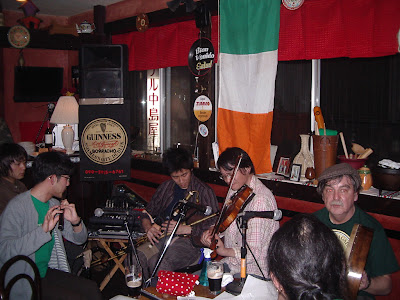
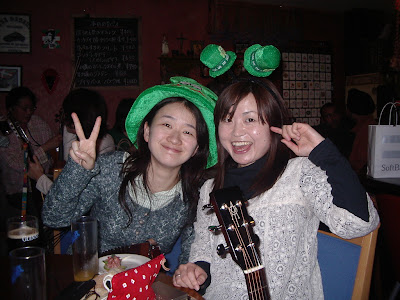
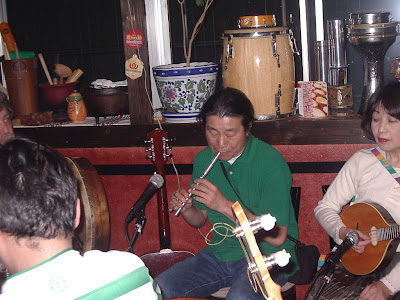
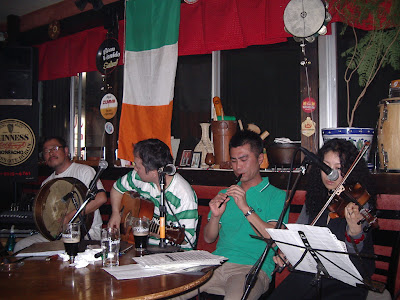
A great night in Shizuoka City brought Saint Patrick's Week to a close. Along with ourselves - the Gang from Hamamatsu - there were two other bands and the place was hopping. Tight music and a really good evening!!!!


Click HERE for Web Album with loads more photos.

Saturday, March 15, 2008

320.Beannachtai Na Féile Pádraig


Fad saol agat, gob fliuch, agus bás in Eirinn.
"Long life to you, a wet mouth, and death in Ireland."

Go raibh tú daibhir i mí-áidh
agus saibhir i mbeannachtaí
go mall ag déanamh namhaid,
go luath a déanamh carad,
ach saibhir nó daibhir, go mall nó go luath,
nach raibh ach áthas agat
ón lá seo amach.

May you be poor in misfortune,
rich in blessings,
slow to make enemies,
quick to make friends,
but rich or poor, quick or slow,
may you know nothing but happiness
from this day forward.

Má dhéanann tu séitéireacht,
go ndéana tú séitéireacht ar an mbás,
má ghoideann tú, go ngoide tú croí mná;
má throideann tú, go dtroide tú i leith do bhráthar,
agus má ólann tú, go n-óla tú liom féin.

If you cheat, may you cheat death.
If you steal, may you steal a woman's heart.
If you fight, may you fight for a brother.
And if you drink, may you drink with me.


Thursday, March 06, 2008

319. St. Paddy's Day is On the Way!

It's that time of year again. Oisin, the very best (if only) Irish band in town, will be playing a series of gigs during St. Patrick's Week, March 16-22. If you live locally, try to make it down. And wear something green ... or else. Or else what, exactly? Buy drinks all round is what!


March 16 (Sun.) - Chez Kao (7 pm - 11ish)
March 19 (Wed.) - Liquid Kitchen (9 pm - late)
March 22 (Sat.) - Guinness Borracho in Shizuoka City, with two other Irish bands. Starts at 7 pm.


Directions later, or check the Bandblog (in Japanese).

Saturday, February 23, 2008

318. A Japanese Manhole


防火貯水槽 : Bou-Ka-Cho-Sui-Sou
(Prevent Fire Protection Water Source)

Thursday, February 21, 2008

317. Gaius Caecilius Metellus

Part the First: In which G. Caecilius Metellus embarks upon a public career.


(These events take place between the 681st and 685th year of the founding of Rome, from the consulship of L. Gellus and Cn. Cornelius Lentulus Clodianus to that of Q. Hortentius Hortalus and Q. Caecilius Metellus)

The envy of Peperna brought them low in the end;
too many drinks at a feast, a sudden flash of swords,
and in the passions born of burning jealousy,
the great general, Sertorius, was cruelly cut down.
I was then just a military tribune, rising nineteen,
under the command of my uncle, Metellus Pius;
when news of the murder made its way to our camp,
I was not the only young officer to sigh with relief.

Fighting in Spain had been harsh and unpleasant,
days of humping dry hills under a punishing sun;
lightning cavalry probes on our flanks, sudden panic,
dead companions, wounds, no trace of the enemy.
With the shrewd Sertorius gone, we soon wrapped it up,
although my laconic Uncle Pius reddened with rage
when Pompey (the ‘Great’) stole away with the credit;
as for me, I was delighted at last to sail home.

Ah, Rome!

You have no idea what it’s like to be back in the city,
to walk again the crowded, cacophonous, colourful streets;
to stroll in the Forum, linger lazily in the baths,
sleep with sultry and scented depilated girls!
My father, cold and stern in the approved old manner,
tipped me out of bed at sunrise on the third morning;
‘Holiday over,’ he grunted, as we stood in the cold atrium,
face to face with ancestral masks, ‘time to get cracking.’

So farewell to low taverns, to louche companions!
I notice, when you stand in the Forum on election morning,
that the white powder that gleams on your snow-bright toga
rises in little puffs, gets up your nose and makes you sneeze.
There I was, poised uneasily, on the bottom lowly rung
of the steep and seemingly lifelong cursus honorum,
a narrow, overcrowded, and quite often lethal ladder
that might lead one day to the dizzy heights of Consul.

I could see friends grinning up from the surging crowds,
as battered bones still ached from the ordeals of Spain;
my father’s clients milled about full of fussy attentions,
with such a formidable family, I had little chance of losing.
Duly elected quaestor, I was assigned to the Treasury,
about the most boring job you could possibly imagine;
daily I put my seal on whole streams of arcane documents,
presented and removed by dour and efficient silent slaves.

The sheer monotony of this unchanging daily routine
very soon made me frantic with the seeds of frustration;
I would slip away for the odd party or secret assignation,
but Boras, that bastard, would infallibly track me down.
Boras, ex-centurion, ex-primus pilus, far-too-loyal retainer,
son of a freedman who had once been slave to the family;
built from brick and scarred marble, doglike in his devotion,
he had no patience for ‘ softarse young pups on the town’.

In my experience, when your fortunes begin to sink low,
they have a way of descending into something far worse;
I’d only months left in the horrible job I’d been stuck with,
when Father announced yet another of his sleek notions.
‘There you are, son,’ he boomed, ‘gods above, you seem peaky!
‘I think it’s time we put a bloom on those pale pasty cheeks.’
O, gods, no, I thought, whatever this is, I really don’t want it!
‘I think it’s time,’ said the parent, ‘to think of your marriage.’

Boras, you evil old snitch, was my first conscious thought,
you ratted on my all-too-rare nights down in the Subura;
Boras’ eyes never once flickered in his long mahogany face,
so, then, I thought, it must be politics – isn't it always politics!
‘We need to steer a careful path,’ said Father, predictably,
‘between the remaining old supporters of Marius and Sulla ;
‘the family is not all that badly placed, but this could change,
‘we need to consider these rising men, Pompey and Crassus.

‘We connect with Pompey through your cousin,’ he continued,
‘But Crassus has no daughters!’ I cried out, without thinking;
this earned a frown from Father, an obelisk stare from Boras,
‘If you will allow me’, said Father, ‘I was thinking of the Julians.
‘But this fellow Caesar is a scheming villain, all piss and vinegar!’
‘He may prove successful, and there's a niece of some sort.’
My heart sank straight to my toes, like a heavy stone within me,
I knew all about young Julia, the ice-cold patrician princess.

I gazed blankly at my father, eyes heavy and dull with horror;
I felt transfixed, like one of the six thousand unfortunate slaves
that Crassus, not so long ago, had roped and nailed to crosses
and left to die, mile after mile of them all along the road to Rome.
‘Cheer up,’ said Father, ‘the betrothal is the thing, she is young.’
She is seven, I thought, which carries scheming a little too far.
‘We need to plan,’ he growled, ‘I command, and you will obey!’
Spain came first, then the Treasury, now this: I must get away.


-------------------------------------------------------------------------------
Brief notes:

- dates: approx. 72-69 BCE
- Sertorian War
- cursus honorarum: elected magistrates
- primus pilus: a sort of regimental sergeant-major
- Subura: a working class red light district in ancient Rome

The Metelli were a prominent senatorial family, conservative in outlook, but determined to preserve the Roman Republic as they understood it. They produced an impressive number of consuls and military leaders but were ultimately unable to prevent a showdown between the dignified political obtuseness of Pompey and the the unscrupulous political brilliance of Caesar, both powerful ambitious men with large armies to call upon. In a real sense, military expansion (the growth of empire) destroyed the republic, a lesson from history to any imperial power that masquerades as a republic at home.
See this article on the family

Part the Second: In which G. Caecilius Metellus abandons for a time his public career


(These events take place between the consulships of L. Caecillius Metellus and Q. Marcius Rex and those of L. Aurelius Cotta and L. Manlius Torquatus)

The quaestor’s job had been tiresome; now Father planned to marry me off,
and not just to anyone, either, he wished to forge an alliance with Caesar.
Much troubled, I went to seek advice from the celebrated M. Tullius Cicero,
whom I had watched, enthralled, during his masterly prosecution of Verres.
When I called on the great man, diffidently, his effusiveness surprised me,
but as a nobody from nowhere, he played up to the scions of older families.
I explained my awkward position and asked for the benefit of his thoughts:
‘Ah, dear impetuous youth,’ he sighed, then smugly intoned, ‘you must obey!’

I thanked him, strapped on my armour and breathlessly ran for the boats.
Quintus, another of my military uncles, had held out one chance of escape
before scheming Father, clutching my testicles, could approach wily Caesar
and offer my services, a sacrificial bull for Julia, his darling only daughter.
A fire-breathing response to what had been an offhand, half-hearted offer
visibly startled Uncle Quintus, this canny no-nonsense fleet commander;
as elder brother to Father, he was quick to understand the lie of the land,
and practically smacked his lips in composing a brusque and formal letter:

Hail, Brother! The People and Senate of Rome, in this hour of crisis,
look as ever to the bravery and fortitude of its young citizen officers,
among whom the fine young men of our family have always been …

Etc., etc.

We campaigned against the pirates of Crete, a bothersome nuisance,
and I found this to be refreshing, a form of violent outdoor exercise;
then, when an ill-planned raid went wrong, I received a slash across the guts
that came close to killing me, and for weeks I languished in some agony,
threatening to die if my worried uncle made an attempt to send me home.
Death passed me by with a whisper, but I knew it would find me in Rome
should I be connected to a woman that I cordially but intensely disliked,
and, more to the point, her ruthless father, who frankly terrified me!

I slipped ashore, a convalescent scholar, on sparkling peaceful Rhodes,
and applied to the school of Molon, former tutor to Cicero and Caesar;
‘Ordinarily, I wouldn’t do this,’ he said, accepting my lavish presents,
for he had cackled rudely at demonstrations of my "slow pedestrian mind”.
I wasn’t offended; I like the Greeks, they are subtle, quick and intelligent,
although incapable of practicalities, such as running their own country.
They make extremely useful slaves, unlike sluggish and belligerent Gauls,
and if you have the sense to flatter them, they can teach you a thing or two.

I took a liking to the local wines, and also to the habit of open discourse,
and was praised, I believe, as a mannerly young fellow, utterly un-Roman.
These were pleasant times, as the pirates faded entirely from view;
the task of clearing them I left to Uncle and, latterly, glory-seeking Pompey.
My father never ceased in his importunate efforts to summon me to Rome,
but well-paid local doctors sent him a series of discouraging reports.
Father recoiled with dread from any thoughts of ships or the sea,
thus I could laze to full recovery, attended by a pair of ravishing sisters.

I forget how long this leisurely life had lasted when it came to my notice
that young Roman visitors seemed to sport strange wispy little beards.
Romans have always been such a notoriously clean-shaven sort of people,
that I was intrigued by this change in fashion and sought these fellows out.
They spoke in reverent tones of some senator, a patrician named Catalina.
I had heard of him, of course, a grasping thug from one of the old families,
he had wilfully murdered for property at the time of Sulla’s proscriptions,
and, so it was said and believed, he had brutally murdered his very own son!

‘A great change will come to Rome,’ these young men were pleased to confide,
‘when all the landlords and lower-class moneylenders will meet their desserts;
'all the old families, the natural elite, will be restored to rightful power.’
Just so, thought I, calling for more wine, but what will Father make of all this?
Hardly a week had passed before his thoughts were forcefully made known.
A slave ran to my gate and delivered a letter from a ship newly docked:
‘Blast your silly wounds!’ it read. ‘Come back to Rome immediately!’
Father’s style, indubitably. Then: ‘I want you to befriend this man Catalina'.

Sunday, February 10, 2008

316. Lillibulero


Lily strolls saucily down the street
with slow embarrassed pleasure;
so young and alive in her new cotton dress,
the young lads watch her at their leisure.

Fairview, the Strand, Newcomen Bridge,
hear the trams come clanging down;
Amiens Street rises right ahead,
where trains rattle in to Dublin town.

O Lily, Lily, me Dublin darlin'
Lily, Lily bulero!

Talbot Street, shadow of the rail bridge,
alive with a load of little shops;
the cries and chants of the old street traders,
the roar of this city never stops.

Walk ahead, Lily dear, to Nelson's Pillar,
one-handled hero in a silly stone hat;
you'll meet your young man at a smart new cake shop,
but you're not quite sure what will follow from that.

O Lily, Lily, me Dublin darlin'
Lily, Lily bulero!

Sure, I don't even know if he's keen on me,
says Lily, agiggle with girlfriends;
he's never even tried to hold my hand,
sweet Lily, Lily bulero!

Now gaily she glides along the Strand,
as greyly the day slides into night;
the young chap that day, he was keen all right,
begorrah, bedad, and begum ...

now he's me Dad, and Lily's me Mum!

----------------------------
(true story !)

Friday, February 08, 2008

315. Foyle's War


Unquestionably, one of the best TV series going. Detective Chief Superintendent Foyle (Martin Kitchen) is based in Hastings on the southeastern coast of England when war breaks out in 1939. Intent at first in getting involved in the war in a more meaningful way, Foyle seeks a transfer from the humdrum police work of running down black marketeers and other petty criminals until murder and intrigue comes knocking at his door. Each episode in this series is a densely woven tale involving two or more subplots unfolding in tandem with the main action. There are no car chases or shoot-outs or any of the wham-bam action of a Hollywood thriller. Instead, the stories unfold with a seemingly leisurely but increasingly complex interplay of characters and events as the war progresses in the background, at first hardly noticeable but then intruding into the action more and more directly as the bombing intensifies and invasion fears increase. The attention to historical accuracy and period detail is extremely impressive with the mood of the series matching closely the popular literature and eyewitness reports of the wartime period. The clothing and the surrounding artifacts such as housing, interior fixtures, street architecture, notices and signs, and above all, the motor cars, are totally believable and one never gets the feeling of watching modern actors pretending to inhabit a recreated past. The characters and atmosphere bring the viewer straight back to the period in a fully believable way. Best of all, the stories are so subtle and so intelligently developed that the viewer before long begins to dread (with hindsight) the inexorable ongoing progress of the war since we all know it ended in 1945 ... and with it so will this series!

Saturday, January 26, 2008

314. Fifteen Haiku


The title is not quite accurate. What we have here is a compilation of perhaps 7 senryuu (川柳) and 8 haiku (俳句). Traditionally, haiku tend to be elevated in tone, more in tune with nature and the passing seasons, whereas senryuu cast a wry and caustic look on human behaviour. Both use exactly the same 5-7-5 syllabic format. I leave it to your judgement to discern which is which.

------------------
1.

late for work again!
hurrying, jostle a blind girl,
I am so sorry.

------------------
2.

millions of insects,
tiny transient tourists --
Japan in summer.

-------------------
3.

two glasses of beer
and his face goes scarlet red --
school reunion.

--------------------
4.

five little girls,
each in summer kimono --
ice-cream drip, drip, drip
---------------------
5.

dark suit and black tie,
another friend passes on --
damp cold misty rain.

----------------------

I realize looking at a whole row of haiku one after another gets a bit tiring. My Japanese friends tend to be rather strict in literary matters and would doubtless class all of the five above and the ten to follow as dubious senryuu. I'll tell you why below.

-----------------------
6.

leaving the office
a whole day of black and white
bursts into colour

-----------------------
7.

at the festival
starlight shines upon your hair
only I can see.

________________
8.

pale and unsmiling,
avoid like hell by daylight --
nightclub Russian girls.

----------------------
9.

here comes Jonathan!
may a truck roll over him --
please please let me drive.

----------------------
10.

a life without love
avoids all complications,
leaves you dead and dry.

----------------------

Time for another break from the poems. They are only truly effective in isolation. A string of them rather dilutes their power and takes away their stand-alone presence, their "is"-ness, for want of a better term. My Japanese friends, to continue, believe that only pure poets can write haiku, which means, in effect, that the poet must be Japanese and will most certainly not write in English!! They do have a point. Modern haiku are sclerotic in the sense that they have been surrounded by an accumulation of so many subtle rules that they have become almost impossible to write by any normal non-expert Japanese, let alone a foreigner. This is a load of drivel, of course, as a glance at the great free-wheeling iconoclasts of the 17th century makes immediately apparent. Unpredictability and originality have since come to be discerned as dangerous and negative values in bureaucratic and "official" Japan with the concomitant need to ruthlessly stamp them out wherever and whenever they occur in the interests of "Wa" -- national harmony. Hence, to cut a rather interesting story short, the "taming" of haiku, along with everything and everyone else, is tied in with the rigidity and uphill struggle of the educational system to come to terms with the modern world and, not coincidentally, the reluctance (if not sheer inability) to deal with the moral burden of the wartime period. Let's leave it there. It's just a bunch of poems .... !

-------------------------------
11.

exploding fireworks --
love booms in our hearts again:
summer kimonos.

______________________
12.

fanatic patriots,
all in a similar daze --
Yasukuni Shrine.

______________________
13.

my private student
shyly exposes her breasts --
what do I do now?

------------------------------
14.

she tells me her name,
says it means "the holy child" --
no, I don't think so.

------------------------------
15.

sake, more sake,
in cups of fresh-cut cedar --
ah, the dancing moon!

-------------------------------

Well, I thought we'd never get to the end but we did. No more haiku from me for a while. See if you can separate them out into senryuu and haiku. Right, so. Good luck.

Sayonara. さようなら
Safe home (well, you're probably there already).

Saturday, December 15, 2007

313.Dubbalin Town

The Irish Cycle: Baile Atha Cliath
Dublin, 2003


Jack B. Yeats "The Liffey Swim"


O, Dublin, sweet and slow,
I come and go
up and down your cobbled streets,
as the rain, insistent,
dampens down the lights,
and throws an orange fuzzy sheen
over half-seen sights,
over places I have been,
some near and some not far:
Grafton Street, Stephen’s Green,
The Coombe and Temple Bar,

The Traitors’ Gate.

Crowds of loud young English
shout and laugh, then urinate,
lavishly, groaning, here on the street,
beside the peagreen Liffey
(sweet Anna Livia Plurabelle);
well, at least they’re not in uniform,
and sure, dammit, what the hell,
it's a far sight worse we’ve seen before,
insurrection, hatred, famine, war:
and such a fine collection of bullet holes
in our central city monuments.

So let the hen parties heave their guts out
on the raincold cobbles:
let them stagger home and say,
what a wild time we had in Dublin!
Let them come back in ten years or so,
with their fourth or fifth bloke,
with all their kids in tow,
and have another drink, a smoke,
perhaps then they'll have some peace
(for peace comes dropping slow)
and echo these words of Louis MacNeice:
This never was my town,
I was not born or bred
Nor schooled here and she will not
Have me alive or dead
But yet she holds my mind
With her seedy elegance,
With her gentle veils of rain
And all her ghosts that walk
And all that hide behind
Her Georgian facades -
The catcalls and the pain,
The glamour of her squalor,
The bravado of her talk.


Sweeney’s the chemist,
where Bloom forgot Molly’s lotion,
is still in Lincoln Place;
and so is the old post office
down on Westland Row:
O you naughty naughty boy!
I do not like that other world.
And please will you tell me
what perfume does your wife wear?
Bloom smell-sipped his glass of burgundy
at Davy Byrne’s, on Duke Street,
a disappointing place these days,
so gentrified. I well remember
how one of the old barmen
was kill’t telling me how Joyce, yer man,
would be writing away at the back table,
dat filthy buik, Allergies, or wha’ever.
Ah, would you fuck off, says I.
Yeh bleedin bowzy, says he,
I took yeh for a fuckin Yank.

Come to Amazing Tourist Dublin!
Stay at our three-and-a-half star hotels;
eat like a pig, drink like a fish,
then lumber,lumber along
our lazy languorous streets.

Buy things!
Pretend the locals are nice to you.
Pretend you are John Wayne,
all quiet and dangerous;
pretend you are Scarlett O'Hara
home at last in Tara

On your ambling aisy rambles
you can squint up the arses,
the cool marble behinds,
of female statues
at our staid and steady National Museum.
Bloom did, our wandering Jew,
so too can you.
No money, honey;
but even stone hearts slowly melt,
so smile, unbuckle your belt,
make a voluntary contribution!
Oops, sorry, Yanks,
no dollars, thanks,
there’s an exchange-rate
revolution: the … the ingratitude!
(but we were neutral in the Second War).
Hang on to your cash, you’ll need it!
Are ye jokin’ or wha’? indeed it
does seem strange, no proper answer,
like a dropkick in the balls
from a reedy ballet dancer.

We still stack up the dead
next to my grandfathers,
maiden aunts, cousins and uncles,
in the wild sprawl of Glasnevin.
Poor poor Paddy Dignam!
(“No home is complete
without Plumtree’s Potted Meat”).
Poor dear betrayed Parnell.
O’Donovan Rossa.
O’Connell.
Emmett.
Tone.
Collins.
Ah, Michael …
Macushla! … cut down at thirty-one,
our greatest chieftain since O’Neill!
Cut down, I might add,
by one of our own.
Why do we do this?
Ask Jonathan (Gulliver) Swift
who suggested, politely,
that the English should eat Irish babies,
help with the balance of payments.
England thought he was serious,
and so did some of the Irish.
“Where can I sell me baby, sorr?”
Well, without you, Michael,
we’d still be prancing around the world
on British passports.

Yerra, Carolan!
Tabhair dom do lamh.*
Give us an oul’ song!

Up on the flinty North Side,
Drumcondra, Marino, Whitehall,
sits my old local, The Goose,
just there by Sion Hill;
I’d be away three years, maybe more,
then I'd stroll into the gaff,
and the lads’d say, where ya been?
Japan. O yeah? Me, I went to Benidorm,
two weeks with the new girlfriend,
fuckin magic! Right, it's my round,
then we’d talk and sing and laugh.
Sometimes An Taoiseach lounges in,
good old Bertie himself, backed up
by hard-looking thugs. “Yo!” says I,
“is it the Prime Minister or his bleedin twin?”
“Ah, Malachy!” says he, priding himself
on his memory for names, a head like tin.
“No,” says I, “isn’t it me myself?”
“O, Jayz, the astronomer … the geographer,
or was it the stamp collector?”
“B-b-b-bertie! You got it in one!”
After that, a pint, a good long chat,
here at “home” in Dublin North:
he may be the grand prime minister,
but he knows where that home is at.

On Bridge Street, down by the City Walls,
sits an ancient pub, the “Brazen Head”,
and many a time and oft have I lingered,
langered, within its stout-built chambers:
this is the oldest pub in Dublin, 1198.
About fifty yards away is the bridge,
the – ‘Atha Cliath’ – the Ford of the Hurdles
from which the city takes its name,
a river crossing on the ‘Sli Cualann’,
one of the five ancient roads of Ireland,
the path from Tara to Glendalough.
That helps explain the licence plates:
we’re the citizens of “Baile Atha Cliath”,
and “Dubh-Linn”, which is also Irish,
is not where we live at all.

In the mean little streets near Christchurch,
winding and awkward to this day,
a proto-Nazi called Major Sirr
cornered the rebel Lord Fitzgerald,
then got himself stabbed for his pains.
Thirty-odd thousand died that year, 1798;
thousands more were transported
in creaking hulks to Australia,
a new setting for Irish prisoners,
a new continent to slowly transform:
America was to come along later.
Not many long years before that,
The Mad Dean of Saint Patrick’s,
that entrepreneur, that pamphleteer,
(the cathedral looms just down the road)
that purveyor of roasted Irish babies,
was laid to rest, now his epitaph
fairly bounces off the wall:
Hic depositum est corpus
JONATHAN SWIFT S.T.D.
Huyus Ecclesiae Cathedralis
Decani
Ubi saeva indignatio
Ulterius
Cor lacerare nequit
Abi Viator
Et imitare, si poteris
Strenuum pro virili
Libertatis Vindicatorem
**

God, it’s an old country,
but the weight comes down like a feather.
Nothing seems heavy, all drops down so lightly.
Freedom. Freedom, more than any other thing,
is central. You can go back through
all the old stories, the legends, the epics,
the Annals of the Four Masters, local histories,
you can listen to the voices of the rebels,
all those who fought and died,
four hundred, two hundred, one hundred years ago,
right on down to recent times,
and you sense this will never change,
you know this will never change.

All the tubby little accountants,
the cross-looking women in large automobiles,
the fierce young sporting men,
the giggling schoolgirls,
the languid poets and philosophers,
the businessmen in suits,
the regulars in the pubs,
the girl secretaries,
the skangers and headbangers,
the bus drivers,
the radio and TV executives,
the Nigerians, the Chinese,
the actors, the musicians,
the polite young Poles,
the flower sellers,
the asylum seekers,
the Spanish students

can gather in the streets, burn down embassies.

Ancient city of an ancient country,
ringed right round by the ocean sea;
great powers that rise and fall around us,
can do as they will, just leave us be.


-------------------------------------------
Brief notes:

- “Dublin” by Louis MacNeice

-- Turlough O’Carolan, blind harper (1670-1738). The title of this composition is “Give Me Your Hand” in English.

-- Bertie Ahern, Irish PM (An Taoiseach – The Leader)

-- The Brazen Head Pub homepage

-- “Dubh-Linn” translates as Black-Pool, the remains of which (now drained) can be seen behind Dublin Castle.

-- Swift’s epitaph, translated from the Latin by W.B. Yeats:

Swift has sailed into his rest.
Savage indignation there
cannot lacerate his breast.
Imitate him if you dare,
world-besotted traveller.
He served human liberty.


-- Annals of the Four Masters Irish chronicles, ca. 2000 BC - 1616 AD

Thursday, November 29, 2007

312. In a Nutshell

In 12 short paragraphs Chris Hedges manages to hit the main points and clarify what it is that causes so many thinking Americans to despair of the course their nation has been taking. Friends and allies overseas have been finding it increasingly difficult to support US policies and public opinion in these countries with regard to America is at an all-time negative low. The more optimistic among America's friends hope that relations will improve with the passing of the current Bush administration, one of the most arrogantly disastrous interludes in American history, but it would probably be more realistic to expect a modification rather than any drastic reversal of US policies and trends no matter which candidate wins the 2008 election.

America in the Time of Empire
http://www.truthdig.com/report/item/20071126_america_in_the_time_of_empire/
Posted on Nov 26, 2007

By Chris Hedges

This column was originally published by the Philadelphia Inquirer.

All great empires and nations decay from within. By the time they hobble off the world stage, overrun by the hordes at the gates or vanishing quietly into the pages of history books, what made them successful and powerful no longer has relevance. This rot takes place over decades, as with the Soviet Union, or, even longer, as with the Roman, Ottoman or Austro-Hungarian empires. It is often imperceptible.

Dying empires cling until the very end to the outward trappings of power. They mask their weakness behind a costly and technologically advanced military. They pursue increasingly unrealistic imperial ambitions. They stifle dissent with efficient and often ruthless mechanisms of control. They lose the capacity for empathy, which allows them to see themselves through the eyes of others, to create a world of accommodation rather than strife. The creeds and noble ideals of the nation become empty cliches, used to justify acts of greater plunder, corruption and violence. By the end, there is only a raw lust for power and few willing to confront it.

The most damning indicators of national decline are upon us. We have watched an oligarchy rise to take economic and political power. The top 1 percent of the population has amassed more wealth than the bottom 90 percent combined, creating economic disparities unseen since the Depression. If Hillary Rodham Clinton becomes president, we will see the presidency controlled by two families for the last 24 years.

Massive debt, much of it in the hands of the Chinese, keeps piling up as we fund absurd imperial projects and useless foreign wars. Democratic freedoms are diminished in the name of national security. And the erosion of basic services, from education to health care to public housing, has left tens of millions of citizens in despair. The displacement of genuine debate and civil and political discourse with the noise and glitter of public spectacle and entertainment has left us ignorant of the outside world, and blind to how it perceives us. We are fed trivia and celebrity gossip in place of news.

An increasing number of voices, especially within the military, are speaking to this stark deterioration. They describe a political class that no longer knows how to separate personal gain from the common good, a class driving the nation into the ground.

“There has been a glaring and unfortunate display of incompetent strategic leadership within our national leaders,” retired Lt. Gen. Ricardo S. Sanchez, the former commander of forces in Iraq, recently told the New York Times, adding that civilian officials have been “derelict in their duties” and guilty of a “lust for power.”

The American working class, once the most prosperous on Earth, has been politically disempowered, impoverished and abandoned. Manufacturing jobs have been shipped overseas. State and federal assistance programs have been slashed. The corporations, those that orchestrated the flight of jobs and the abolishment of workers’ rights, control every federal agency in Washington, including the Department of Labor. They have dismantled the regulations that had made the country’s managed capitalism a success for ordinary men and women. The Democratic and Republican Parties now take corporate money and do the bidding of corporate interests.

Philadelphia is a textbook example. The city has seen a precipitous decline in manufacturing jobs, jobs that allowed households to live comfortably on one salary. The city had 35 percent of its workforce employed in the manufacturing sector in 1950, perhaps the zenith of the American empire. Thirty years later, this had fallen to 20 percent. Today it is 8.8 percent. Commensurate jobs, jobs that offer benefits, health care and most important enough money to provide hope for the future, no longer exist. The former manufacturing centers from Flint, Mich., to Youngstown, Ohio, are open sores, testaments to a growing internal collapse.

The United States has gone from being the world’s largest creditor to its largest debtor. As of September 2006, the country was, for the first time in a century, paying out more than it received in investments. Trillions of dollars go into defense while the nation’s infrastructure, from levees in New Orleans to highway bridges in Minnesota, collapses. We spend almost as much on military power as the rest of the world combined, while Social Security and Medicare entitlements are jeopardized because of huge deficits. Money is available for war, but not for the simple necessities of daily life.

Nothing makes these diseased priorities more starkly clear than what the White House did last week. On the same day, Tuesday, President Bush vetoed a domestic spending bill for education, job training and health programs, yet signed another bill giving the Pentagon about $471 billion for the fiscal year that began Oct. 1. All this in the shadow of a Joint Economic Committee report suggesting that the wars in Iraq and Afghanistan have been twice as expensive than previously imagined, almost $1.5 trillion.

The decision to measure the strength of the state in military terms is fatal. It leads to a growing cynicism among a disenchanted citizenry and a Hobbesian ethic of individual gain at the expense of everyone else. Few want to fight and die for a Halliburton or an Exxon. This is why we do not have a draft. It is why taxes have not been raised and we borrow to fund the war. It is why the state has organized, and spends billions to maintain, a mercenary army in Iraq. We leave the fighting and dying mostly to our poor and hired killers. No nationwide sacrifices are required. We will worry about it later.

It all amounts to a tacit complicity on the part of a passive population. This permits the oligarchy to squander capital and lives. It creates a world where we speak exclusively in the language of violence. It has plunged us into an endless cycle of war and conflict that is draining away the vitality, resources and promise of the nation.

It signals the twilight of our empire.

Saturday, November 10, 2007

311. Forgotten Debts: 1914-18


They shall grow not old, as we that are left grow old:
Age shall not weary them, nor the years condemn.
At the going down of the sun and in the morning
We will remember them.
------------------------------------
Please go here for the original, longer article.

Sunday, November 04, 2007

310. The Irish Cycle: Lord Malahide


Fourteen years. Two children.
One miscarriage; her racking sobs in the night.
Her eyes reveal nothing; I hardly know her.

Her eyes are hazel with flecks of green,
She has noble carriage, a proud woman’s gait;
Her black sweeping hair has a blueish sheen,
She stands before me, my wife and mate.


- Dear wife.
- My lord husband.

Why have I ignored her all these years,
Under the one roof, food from the one table;
My voice when I speak holds back the tears:
Can I bridge this chasm, am I still able?


- The children?
- Quite safe, My Lord. They sleep.
- I have need to speak with you.
- My Lord?
- Come, let us move into a private chamber.
- Shall I disrobe?
- No, no, no, no, no – it’s not like that at all!
- Have I displeased you in some way?
- Not at all, my dear, quite the contrary.

O’REILLY !!!

- Sir, yes sir?
- Bring us some wine, like a good fellow.
- Very good, sir. The usual, is it?
- No, no … bring in the good Spanish.
- Not much left, sir. Are ye sure?
- Just do what I tell you, dammit!
- Rightyo, sir.
- And don’t say rightyo!
- Righty …very good, sir.

We move into the wind-cooled room,
It has Italian marble walls and floor;
There is a passing chill, a hint of the tomb,
I softly, firmly, shut the door.


- My Lord?
- My dear, I cherish and respect you.
- My Lord is most gracious.
- O, stop that! The fact is I love you.
- Love, my Lord?
- Perhaps I haven’t made my feelings plain.
- Lady Agnes, Lady Jane,
Lady Patricia, the parlour maid,
and that little blonde wench in the kitchen?
My Lord has made his feelings plain enough.
- O, come now, that means nothing!
- My Lord, I think it does.

Knock-knock

- What now?
- The wine, sir.
- Bring it in, blast you!
- Rightyo, sir.
- And don’t you bloody well …
- Ah, sorry, sir.
The good Spanish, sir.
Not much left of it, mind,
I was just after telling the cook …
-Would you kindly pour the wine, O’Reilly?
Pour the wine, man, and clear off!
- There was fourteen sat down to breakfast
and every one, sir, was dead before dinner.
- What? Not now, O’Reilly.
- Tis a vision, sir. I saw it clearly.
These things will come to pass.
- I’ll wring your bloody neck, O’Reilly.
How’s that for a vision?
- Rightyo, sir.

A pause. A tasteless sip of priceless wine.

- My dear, the situation …
- I am aware of the situation.
The enemy has marched from Dublin.
We will soon be under attack.
- Yes, well, I suppose the whole castle knows.
- And now my Lord is … afraid?

When she spoke those words, love drained from my heart,
I gazed at her coldly from across four hundred years;
Like my forefathers I too could play my part,
I would never, could never, succumb to my fears.

- You misunderstand me, my Lady.
- I think I understand you well enough.
- I see. You will stay with the children.
Neither they nor you will come to any harm.

There was a glint in her eyes, a hint of derision,
a mockery in those hazel, green-flecked eyes,
and I could suddenly catch a glimpse of myself
as seen by this woman through all those years.
Upon this, not the battle, I reflected, ruefully,
as I strapped on my nearly new armour
and called for my old but sharpened sword.

Soon came the enemy to the gates:
dear God, these brazen, upstart English!
Well, it was the usual confused affair,
a lot of noise and dust and private agony.
We were deemed to have won since we didn’t quite lose,
the traditional form of Irish victory,
and our lives settled back to the normal round.

I continue to live at the castle,
Richard, Lord Admiral of Malahide
and the adjoining seas surrounding,
with my lady wife and children.
She looks at me now with apprehension.
O’Reilly has a brother, a prosperous smuggler;
we have twenty new barrels of good Spanish wine.
Upon occasion, as a means of diversion,
I ride to Dublin with a light escort,
there to visit certain friends of mine.

-----------------------------------------------------------------------------
Malahide Castle was built by the Talbots in 1185 and remained in the family until the death of the last in the male line, Sir Milo, in 1973. On the morning of July 1, 1689 (by the Old Calendar) fourteen men of the family sat down together for breakfast and by nightfall all fourteen had fallen at the Battle of the Boyne. The castle and surrounding parklands were sold to the Irish State in 1975 and are a popular picnic destination for Dubliners. The pleasant seaside village bearing the same name is now home to Adam Clayton and the Edge of the rock band U2.

Tuesday, October 16, 2007

309. Karl of the Corporation


circular arguments
bedazzle rigid minds

I was reinforced in my dominion
by ignorance and by stubborn pride,
by a belief in only one opinion.
Stand out of my way, sir,
if you know what is good for you.

I lied,
because I could not tell the truth.
Bare facts, an abomination,
lacked the salt of imagination.
I tried
to explain things always in a way
that would meet some expectation.
Unwelcome possibilities
got themselves shot down
like darkies in a cornfield,
like wetbacks in a river.
The bosses didn’t care:
never shouldn’ta oughta bin there.
Mow them down, rat-a-tat-tat
jump in the car and hit the town,
then talk of Rembrandt and Cezanne
and try to fondle Sally Anne.
Do the same old thing tomorrow,
a well-dressed man of constant sorrow.

***
Many versts across the barren fields
from the shining palaces of Petersburg,
a girl with snow-white arms upraised:
O Bog, she says (their word for God),
O Bog, get me out of here!

***
As an unwanted child,
lonely, destructive, anti-social,
I had no trouble believing
that God was indeed a special friend.
Little then did I know
what I've come to know in the end.
The Church, as ever, opened its arms
and welcomed my delusion;
it prays and preys upon
adolescence and confusion.
My son, do you have a vocation?
Get away to fuck.
(Get away to fuck, Father ).
I was not in the habit of talking to strangers,
unless, of course, idiot tourists,
eager and uncertain,
looking for a place to spend hard cash.
A furry masculine moustache
began with the hairs around my groin,
it would join in the fortunes of those parts,
the intricate lies, the broken hearts,
the additions, loans, debentures,
the many cold-eyed cheap adventures.
I held one truth to be self-evident,
that all men procreated
pretty much continuously,
so in order to stand out
one had to be a bit of a bastard.
In fact, I mastered the mechanics
at about the age of six,
an enlightening heady mix
of bluff and certain knowledge,
so that all the blows and cuffs and kicks
of the ambient adult world
became a poor boy’s college.
I’ll tell you one thing,
you can forget the rest:
those to whom evil is done
do certain evil in return.
They burn
with righteous and amoral wrath
they cleave a hard and frightening path
between the innocent and the innocent.
Stand out of my way, sir,
if you know what is good for you.

The guilty they leave well alone
(those boys can be dangerous).
I never really fell in love
until seven years ago.
I had a carapace of immunity,
ready-made, form-fitting,
born of the arrogant impunity
of treating people as things.
But I find love brings
little happiness, less relief.
It is my sad and certain belief
that love can never be learned
nor earned
when a loveless child becomes a man.
My plan
was to rule the world
or at least my little bit of it.
Then the whiskey got in the way.
God bless the whiskey;
pity it wasn’t tears instead.

Thursday, October 04, 2007

308. Ritter's Quiz


Scott Ritter, an intelligence specialist with a 12-year career in the U.S. Marine Corps, joined the United Nations weapons inspections team, or UNSCOM in 1991. He participated in 34 inspection missions in Iraq, 14 of them as chief inspector. Ritter resigned from UNSCOM in August 1998, citing US interference in the work of the inspections. Since then he has become a vociferous and outspoken critic of US Middle East policy, in particular the "selling" of the Second Iraq War to the American public. Recently he has been trying to warn that similar falsifications and misrepresentations will be employed by the Bush administration to justify an assault on Iran. Two of the main themes in his articles and public appearances are that the American public does not understand its own Constitution and has allowed the current administration to undermine it seriously if not fatally under the rubric of the Global War on Terror, and that the US public has little if any understanding (or interest) in the historical tensions that have been causing a rise in fundamentalism within the world of Islam.

Ritter writes:

The task of holding Congress to account is a daunting one, and can be accomplished only if the citizenry that forms the respective constituencies of our ignorant congressional representatives are themselves able to operate at an intellectual capacity above that of those they are holding to account. So rather than issue “pop quizzes” to our elected representatives, I’ve designed one for us, the people. If the reader can fully answer the question raised, then he or she qualifies as one capable of pointing an accusatory finger at Congress as its members dither over what to do in Iraq. If the reader fails the quiz, then there should be an honest appraisal of the reality that we are in way over our heads regarding this war, and that it is irresponsible for anyone to make sweeping judgments about the ramifications of policy courses of action yet to be agreed upon. Claiming to be able to divine a solution to a problem improperly defined is not only ignorant but dangerously delusional.

So here is the quiz: Explain the relationship between the Iraqi cities of Karbala and Baghdad as they impact the coexistence of Iraq’s Shiite and Sunni populations.

Most respondents who have a basic understanding of Iraq will answer that Karbala is a city of significance to Iraq’s Shiite population. Baghdad is Iraq’s capital, with a mixed Sunni and Shiite population. If that is your answer, you fail.

Click here to read the rest of Ritter's article "Calling Out Idiot America"

307. Adam&Eve

Hamid Bahrami is an Iranian cartoonist. Check out his work here.

Wednesday, October 03, 2007

306. The Grand Shrine at Ise

According to Japanese legend, around 2,000 years ago the divine Yamatohime-no-mikoto, daughter of the Emperor Suinin, set out from Mt. Miwa in modern Nara Prefecture in search of a permanent location to worship the goddess Amaterasu-omikami, wandering for 20 years through the regions of Ohmi and Mino. Her search eventually brought her to Ise, in modern Mie Prefecture, where she is said to have established Naikũ ( the Inner Shrine) after hearing the voice of Amaterasu Omikami saying that she wanted to live forever in the richly abundant area of Ise, near the mountains and the sea. Prior to Yamatohime-no-mikoto's journey, Amaterasu-omikami had been worshiped at the Imperial residence in Yamato, then briefly at a temporary location in the eastern Nara basin.


Officially known simply as Jingū or "The Shrine," Ise Jingū is in fact a shrine complex composed of over one hundred individual shrines, divided into two main parts. Gekū (外宮), or the Outer Shrine, is located in the town of Yamada and dedicated to the deity Toyouke no ōmikami, the deity responsible for sacred offerings of food to Amaterasu, while Naikū (内宮), or the Inner Shrine, is located in the town of Uji and dedicated to Amaterasu ōmikami. The two are located some six kilometers apart, joined by a pilgrimage road that passes through the old entertainment district of Furuichi. The High Priest or Priestess of the Ise Shrine must come from the Japanese Imperial Family, and watches over the Shrine.

According to the official chronology, the shrines were originally constructed in the year 4 BC, but most historians date them from several hundred years later, with 690 AD widely considered the date when the shrines were first built in their current form. Legends say that Naikū was established by Yamatohime-no-mikoto. The shrines are mentioned in the annals of the Kojiki and Nihonshoki (dating from 712 and 720, respectively).

The architectural style of the Ise shrine is known as Shinmeizukuri (神明造) and may not be used in the construction of any other shrine. The old shrines are dismantled and new ones built to exacting specifications every 20 years at exorbitant expense, so that the buildings will be forever new and forever ancient and original. The present buildings, dating from 1993, are the 61st iteration to date and are scheduled for rebuilding in 2013.

Gagaku Court dance


Site of the older shrine, now rebuilt behind the wooden fence to the right


Modern worshippers cluster at the rebuilt 1993 shrine (Note security guard at left reminding me photos are strictly forbidden within the shrine precincts! Oops.)

Friday, August 10, 2007

305. The No Name Bar Symposium

It's 2 am -- and the Usual Suspects gather round the table.
The discussion kicks off and soon slips into second gear ...
... while Da Boss (Mehmet the Wise) lays it on the line ...
... and the Valued Customer (Sam the Man) responds in kind ...
... as Chris takes all of this serious stuff in ...
... and So Hee thinks, it's 3 am and they're just getting started!!

Monday, August 06, 2007

304. Tambourine

Arrows pierced the hut when I was seven,
and my father fell stricken on the hob;
a chap with an axe finished off the job,
me Ma was screaming and I was silently

cheering them on, wide-eyed, frightened,
peering up from under the table.

Bad cess to me Daddy, thank God he's gone!
But me Ma, by God, was in floods of tears.
How can ye mourn him after all those years?
Ah, he was my heart and soul and moon and sun!

I shall never understand women.

The Sassenachs came when I was fifteen.
I was given a spear, shoved into the line;
sure, stay in the middle, lad, and ye'll be fine!
But they hit us in the middle and front and sides.

Bleedin disaster.

Dear God, these people had horses
the size of bloody giraffes,
and better dressed, too, than we were;
they sliced us up and killed us in dozens.

I went to ground in the woods of Wicklow,
and met a sweet girl, her name was Marie.
She said, young man, I cannot sleep with thee
until Ireland once again is free!

Molly Ivors.

I slippy-slided back to Dubbalin:
sure where else could I hope to go?
Malaga.
Taormina.
Benidorm.
Hydra.
Phuket.
Penang.

Go local in Kyoto?
One photo
says it all.

Shalangalang. Smack.

That was then.
This is now.

I have the power of prediction.
I have lived six hundred years.
That's OK. No, really.

There is a notch in the hills,
just there, please look at the horizon
as the sun goes sinking down.
This is why I love Africa.
Egypt, on the other hand, reeks; it does;
it has the smell of the Pharaohs,
the stink of whips and chains.
Stone pyramids.
Nazi mentality.

And I love the Greeks
for no good reason.
They delivered us freedom
to smash 200 plates
to bouzouki music.
God, how we enjoy that!
When we are slightly drunk
there is nothing better
than to sling around plates
unless you want to slap your wife
or kill your girlfriend.

Love turns sour in the baking sun.

Inspector Robinson, CID,
made an arrest
on Mykonos.
Jesus, that took balls.
The walls
gathered close around him.
Been there? You know
just what I mean. Deadly.
Israel? Don't even think about it.
Fifty-five machine guns
for every hundred yards.
Trigger happy maniacs.
Bad fuckin bastards,
and only half of them
in uniform. I tell no lie.

If you and I could fly
across the deep and wine-dark sea,
there could be hope, there could be love and mystery,
in the ancient cradle of our history.
We could look to the rising of the sun,
but some idiot fucker has a gun.

Come little lad, come home to me.
This world pushes kids like you to take it:
when you grow to a man you can shove and shake it
like a tambourine; I seen
that so many, so many times.
And not a thing you do
(I loved that girl)
not a single solitary thing
(I loved her from the start)
will make
the slightest difference.