tracing
the tendrils
of lazily
curling steam
rising
from this cup of tea
reminds me
of Proust's
madeleine
and the
formidable
unlikelihood
of employing
mere memory
to salvage
anything
akin to truth
Tuesday, May 31, 2005
Sunday, May 29, 2005
180. fishing in belfast
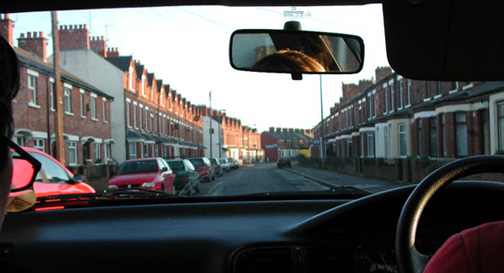
a sun-speckled dazzle
dancing coins of light
the wet water
Liam, before he died
so horribly ...
the windshield wipers
chick, thunk ... chick, thunk,
outside the Northern Bank and Trust,
the rain gleaming streets
almost beautiful,
slashed with reflected neon ...
Duran-Duran
Bon Jovi
the wink and shine
on each individual bullet
Help me find Thy grace, O Lord,
now in my hour of need
such sweaty hands, a Belgian
gun: is the safety off? which
way does it go?
You can crucify me
upside down, I haven't
tried that before.
A gun in my hand
feels good, redirects
the course of Empire.
I am a soldier
I will answer none of your questions.


179. seven past mental
in a lonely ditch with a nagging bitch
domestication overcame me
my sad eyed lady of the lowlands
half-cut, leaning leftwards in the breeze,
bouncing off trees, losing
the run of herself
oh! oh! entirely
so I went to the pissart convention
straight down the old red lane
with stout Cortez, an eagle of a man,
or was that Pissaro
gazing goggle-eyed,
rehearsing
on the Hill of Howth?
We were
half-cut, leaning in the breeze,
leaning and linking serenely,
floating over the flushed and happy faces
of the lusty multitude, singing,
loudly, lovingly,
their anthem at the races:
there were four and twenty virgins
at the Ball of Inverness
and when the ball was over
there were four and twenty less
and in another corner of a foreign field
young Jimmy the Bollix and Gaston Grey
languished
among the lazy langourous lilacs,
gesticulating, interpolating,
Wolfsbane
Sinn Fein
and fifty feckin reasons
to kill your mam
and love your dad
the only peace I ever had
was seven past mental
alone in the flat in Islandbridge
but with two suns in a blazing sky
closing in, approaching,
there was this ... apprehension
(a temporary illusion)
of permanent impermanence
and I thought (that was then)
Mr Death was not worth dying for:
because like any sensible man
I was all for a bit of silence
but, Jayz, Mr D went a step too far
in the other direction. Beyond the gallows,
you may discern
the psychological centre
of the healthy happy human mind:
pre-Revolutionary
pre- Communist
pre-Fascist
pre- American
prelapsarian
as when in days of innocent youth
we laughed with girls and told the truth
but let me
put some interpretation
upon your scalp
and rub it in with kneading fingers
as the needing lingers
and
the clocks
tick
on
Shantih ... Shantih ... with a dull sound at the stroke of eleven.
domestication overcame me
my sad eyed lady of the lowlands
half-cut, leaning leftwards in the breeze,
bouncing off trees, losing
the run of herself
oh! oh! entirely
so I went to the pissart convention
straight down the old red lane
with stout Cortez, an eagle of a man,
or was that Pissaro
gazing goggle-eyed,
rehearsing
on the Hill of Howth?
We were
half-cut, leaning in the breeze,
leaning and linking serenely,
floating over the flushed and happy faces
of the lusty multitude, singing,
loudly, lovingly,
their anthem at the races:
there were four and twenty virgins
at the Ball of Inverness
and when the ball was over
there were four and twenty less
and in another corner of a foreign field
young Jimmy the Bollix and Gaston Grey
languished
among the lazy langourous lilacs,
gesticulating, interpolating,
Wolfsbane
Sinn Fein
and fifty feckin reasons
to kill your mam
and love your dad
the only peace I ever had
was seven past mental
alone in the flat in Islandbridge
but with two suns in a blazing sky
closing in, approaching,
there was this ... apprehension
(a temporary illusion)
of permanent impermanence
and I thought (that was then)
Mr Death was not worth dying for:
because like any sensible man
I was all for a bit of silence
but, Jayz, Mr D went a step too far
in the other direction. Beyond the gallows,
you may discern
the psychological centre
of the healthy happy human mind:
pre-Revolutionary
pre- Communist
pre-Fascist
pre- American
prelapsarian
as when in days of innocent youth
we laughed with girls and told the truth
but let me
put some interpretation
upon your scalp
and rub it in with kneading fingers
as the needing lingers
and
the clocks
tick
on
Shantih ... Shantih ... with a dull sound at the stroke of eleven.
Sunday, May 22, 2005
177. Continuation of Post 169
Back again. Thought I'd forgotten, didn't you? Well, you'd be right ....
Where were we?
"Well-meaning friends often ask a senseless question (your enemies couldn’t be bothered): “Are you happy?” There is no possible answer to this. Happiness is as fleeting as spring weather in the offshore Atlantic islands and just as evanescent."
The notion of the "pursuit of happiness" is a product of pre-revolutionary France -- allow me to give that nail another whack, a product of the FRENCH Enlightenment -- and it only later, as a knock-on, became so famously enshrined in the American Declaration of Independence, a peculiar and impressive document in more ways than one. Nothing about that Declaration is self-evident, and most emphatically not at the time it was written. Now, you can pursue happiness all you like, chums, but you will never catch this elusive little thing, much less possess it. Happiness flows through our clutching fingers like water through a sieve.
Does happiness exist? Definitely. But far from we being the ones who "pursue" it, happiness actually stalks us and creeps up behind us, all unbeknownst, to swoop down suddenly in surprising and very fleeting raids of pleasure: your child takes his first two or three steps, your work is praised by colleagues you respect, the girl you pine for suddenly throws off her clothes, a thousand and one dizzy, silly, wonderful things ....
The fact that we take so many photographs on family and other occasions and the way we endlessly award certificates and medals to the somewhat worthy amongst us is the final and incontravertible proof that happiness cannot be quantified, cannot be measured, cannot be pinned down. The old, in particular, surround themselves with photographs and other mementos of the past. We all do. But what is this, if not an acknowledgement that none of us can hold on to the moments that give us pleasure?
Well, we can hold on to the "things" that give us pleasure -- land, houses, horses, cars, jewellery, subordinate human beings. This appears to be not so difficult but descends inevitably (slowly, then rapidly) into a pit of bottomless sorrow.
We come naked into this life, and naked we leave it.
Where is this essay going? I don't know. That, in itself, is hardly untypical since I have grown used to living with a brain that doesn't often tell me what it's doing.
Herodotus mentions in his Histories that the Persians of his day (circa 400 BC) would make all important decisions twice. First they would consult with their elders and friends, consider all the pros and cons, and have a really good think. Then they would go out and get roaring drunk. If the two "decisions" coincided -- sober and drunk -- they would go ahead with their plans, otherwise not. And the drunken decision took precedence. I have to say this made a tremendous and lasting impression on me when I first read about it (I was probably about 14) and I have never made a decision since without getting drunk seven or eight times -- just to make sure, you understand.
It's not a fool-proof system. Look at me.
Now is when we can start talking about dreams but we are not going to. That would take us off the trail, across the river, and halfway up the mountain.
Another question one gets asked (I do) is "what is the most important thing in your life?" On occasions I have received questionnaires on this ridiculous subject from inquisitive high school students and crocodile corporations. Generally, you are given a list of things -- in no particular order -- which you are then meant to sort out and assign priorities to: family, friends, career, money, health, hobbies, religion, obsessions, and so on and so forth.
Strangely enough, all these lists tend to leave out the most important thing of all -- freedom. Total, sheer, and absolute.
Freedom doesn't mean you can behave like an asshole, mind you. Well, you can. But somebody will shoot you, and you'll probably deserve it.
Freedom -- and by this I mean the intelligent and creative use of freedom (don't ask, still in beta testing) -- is the most important and essential gift life offers. It's a gift we are constantly trying to get rid of, too, if standard human behaviour is anything to go by.
All of us, by definition, are social beings. Even our thoughts about individuality and uniqueness are determined by the understanding of our relationships with others -- including the warped decision to stop having such relations. Language is a case in point. We learn the language of the society and culture we grow up in. Everybody does. How do we learn our first language? Nobody really knows; perhaps our brains are hardwired for what is essentially an intensely social process. Try learning a second or third language -- and I mean learning to speak another language well -- and you will discover with a flash of insight that the way you think is totally conditioned by the language you speak. A monolingual person is a mental cripple who just doesn't realize it.
More later. Maybe.
Where were we?
"Well-meaning friends often ask a senseless question (your enemies couldn’t be bothered): “Are you happy?” There is no possible answer to this. Happiness is as fleeting as spring weather in the offshore Atlantic islands and just as evanescent."
The notion of the "pursuit of happiness" is a product of pre-revolutionary France -- allow me to give that nail another whack, a product of the FRENCH Enlightenment -- and it only later, as a knock-on, became so famously enshrined in the American Declaration of Independence, a peculiar and impressive document in more ways than one. Nothing about that Declaration is self-evident, and most emphatically not at the time it was written. Now, you can pursue happiness all you like, chums, but you will never catch this elusive little thing, much less possess it. Happiness flows through our clutching fingers like water through a sieve.
Does happiness exist? Definitely. But far from we being the ones who "pursue" it, happiness actually stalks us and creeps up behind us, all unbeknownst, to swoop down suddenly in surprising and very fleeting raids of pleasure: your child takes his first two or three steps, your work is praised by colleagues you respect, the girl you pine for suddenly throws off her clothes, a thousand and one dizzy, silly, wonderful things ....
The fact that we take so many photographs on family and other occasions and the way we endlessly award certificates and medals to the somewhat worthy amongst us is the final and incontravertible proof that happiness cannot be quantified, cannot be measured, cannot be pinned down. The old, in particular, surround themselves with photographs and other mementos of the past. We all do. But what is this, if not an acknowledgement that none of us can hold on to the moments that give us pleasure?
Well, we can hold on to the "things" that give us pleasure -- land, houses, horses, cars, jewellery, subordinate human beings. This appears to be not so difficult but descends inevitably (slowly, then rapidly) into a pit of bottomless sorrow.
We come naked into this life, and naked we leave it.
Where is this essay going? I don't know. That, in itself, is hardly untypical since I have grown used to living with a brain that doesn't often tell me what it's doing.
Herodotus mentions in his Histories that the Persians of his day (circa 400 BC) would make all important decisions twice. First they would consult with their elders and friends, consider all the pros and cons, and have a really good think. Then they would go out and get roaring drunk. If the two "decisions" coincided -- sober and drunk -- they would go ahead with their plans, otherwise not. And the drunken decision took precedence. I have to say this made a tremendous and lasting impression on me when I first read about it (I was probably about 14) and I have never made a decision since without getting drunk seven or eight times -- just to make sure, you understand.
It's not a fool-proof system. Look at me.
Now is when we can start talking about dreams but we are not going to. That would take us off the trail, across the river, and halfway up the mountain.
Another question one gets asked (I do) is "what is the most important thing in your life?" On occasions I have received questionnaires on this ridiculous subject from inquisitive high school students and crocodile corporations. Generally, you are given a list of things -- in no particular order -- which you are then meant to sort out and assign priorities to: family, friends, career, money, health, hobbies, religion, obsessions, and so on and so forth.
Strangely enough, all these lists tend to leave out the most important thing of all -- freedom. Total, sheer, and absolute.
Freedom doesn't mean you can behave like an asshole, mind you. Well, you can. But somebody will shoot you, and you'll probably deserve it.
Freedom -- and by this I mean the intelligent and creative use of freedom (don't ask, still in beta testing) -- is the most important and essential gift life offers. It's a gift we are constantly trying to get rid of, too, if standard human behaviour is anything to go by.
All of us, by definition, are social beings. Even our thoughts about individuality and uniqueness are determined by the understanding of our relationships with others -- including the warped decision to stop having such relations. Language is a case in point. We learn the language of the society and culture we grow up in. Everybody does. How do we learn our first language? Nobody really knows; perhaps our brains are hardwired for what is essentially an intensely social process. Try learning a second or third language -- and I mean learning to speak another language well -- and you will discover with a flash of insight that the way you think is totally conditioned by the language you speak. A monolingual person is a mental cripple who just doesn't realize it.
More later. Maybe.
Thursday, May 19, 2005
175. Papers hail fighting Galloway

The newspapers all agree that George Galloway - in the words of the Express - came out all guns blazing when he faced his accusers in the US Senate.
It was a powerful performance, the Times says, while the Telegraph describes an assault on Capitol Hill.
The Financial Times acknowledges blistering testimony, while the Guardian lauds street fighting form.
The Sun admits a barnstorming performance, while the Daily Record says the MP "spanked the Yanks".
Galloway vs. The US Senate: Transcript of Statement
George Galloway, Respect MP for Bethnal Green and Bow, delivered this statement to US Senators today who have accused him of corruption
"Senator, I am not now, nor have I ever been, an oil trader. and neither has anyone on my behalf. I have never seen a barrel of oil, owned one, bought one, sold one - and neither has anyone on my behalf.
"Now I know that standards have slipped in the last few years in Washington, but for a lawyer you are remarkably cavalier with any idea of justice. I am here today but last week you already found me guilty. You traduced my name around the world without ever having asked me a single question, without ever having contacted me, without ever written to me or telephoned me, without any attempt to contact me whatsoever. And you call that justice.
"Now I want to deal with the pages that relate to me in this dossier and I want to point out areas where there are - let's be charitable and say errors. Then I want to put this in the context where I believe it ought to be. On the very first page of your document about me you assert that I have had 'many meetings' with Saddam Hussein. This is false.
"I have had two meetings with Saddam Hussein, once in 1994 and once in August of 2002. By no stretch of the English language can that be described as "many meetings" with Saddam Hussein.
"As a matter of fact, I have met Saddam Hussein exactly the same number of times as Donald Rumsfeld met him. The difference is Donald Rumsfeld met him to sell him guns and to give him maps the better to target those guns. I met him to try and bring about an end to sanctions, suffering and war, and on the second of the two occasions, I met him to try and persuade him to let Dr Hans Blix and the United Nations weapons inspectors back into the country - a rather better use of two meetings with Saddam Hussein than your own Secretary of State for Defense made of his.
"I was an opponent of Saddam Hussein when British and Americans governments and businessmen were selling him guns and gas. I used to demonstrate outside the Iraqi embassy when British and American officials were going in and doing commerce.
"You will see from the official parliamentary record, Hansard, from the 15th March 1990 onwards, voluminous evidence that I have a rather better record of opposition to Saddam Hussein than you do and than any other member of the British or American governments do.
"Now you say in this document, you quote a source, you have the gall to quote a source, without ever having asked me whether the allegation from the source is true, that I am 'the owner of a company which has made substantial profits from trading in Iraqi oil'.
"Senator, I do not own any companies, beyond a small company whose entire purpose, whose sole purpose, is to receive the income from my journalistic earnings from my employer, Associated Newspapers, in London. I do not own a company that's been trading in Iraqi oil. And you have no business to carry a quotation, utterly unsubstantiated and false, implying otherwise.
"Now you have nothing on me, Senator, except my name on lists of names from Iraq, many of which have been drawn up after the installation of your puppet government in Baghdad. If you had any of the letters against me that you had against Zhirinovsky, and even Pasqua, they would have been up there in your slideshow for the members of your committee today.
"You have my name on lists provided to you by the Duelfer inquiry, provided to him by the convicted bank robber, and fraudster and conman Ahmed Chalabi who many people to their credit in your country now realize played a decisive role in leading your country into the disaster in Iraq.
"There were 270 names on that list originally. That's somehow been filleted down to the names you chose to deal with in this committee. Some of the names on that committee included the former secretary to his Holiness Pope John Paul II, the former head of the African National Congress Presidential office and many others who had one defining characteristic in common: they all stood against the policy of sanctions and war which you vociferously prosecuted and which has led us to this disaster.
"You quote Mr Dahar Yassein Ramadan. Well, you have something on me, I've never met Mr Dahar Yassein Ramadan. Your sub-committee apparently has. But I do know that he's your prisoner, I believe he's in Abu Ghraib prison. I believe he is facing war crimes charges, punishable by death. In these circumstances, knowing what the world knows about how you treat prisoners in Abu Ghraib prison, in Bagram Airbase, in Guantanamo Bay, including I may say, British citizens being held in those places.
"I'm not sure how much credibility anyone would put on anything you manage to get from a prisoner in those circumstances. But you quote 13 words from Dahar Yassein Ramadan whom I have never met. If he said what he said, then he is wrong.
"And if you had any evidence that I had ever engaged in any actual oil transaction, if you had any evidence that anybody ever gave me any money, it would be before the public and before this committee today because I agreed with your Mr Greenblatt [Mark Greenblatt, legal counsel on the committee].
"Your Mr Greenblatt was absolutely correct. What counts is not the names on the paper, what counts is where's the money. Senator? Who paid me hundreds of thousands of dollars of money? The answer to that is nobody. And if you had anybody who ever paid me a penny, you would have produced them today.
"Now you refer at length to a company names in these documents as Aredio Petroleum. I say to you under oath here today: I have never heard of this company, I have never met anyone from this company. This company has never paid a penny to me and I'll tell you something else: I can assure you that Aredio Petroleum has never paid a single penny to the Mariam Appeal Campaign. Not a thin dime. I don't know who Aredio Petroleum are, but I daresay if you were to ask them they would confirm that they have never met me or ever paid me a penny.
"Whilst I'm on that subject, who is this senior former regime official that you spoke to yesterday? Don't you think I have a right to know? Don't you think the Committee and the public have a right to know who this senior former regime official you were quoting against me interviewed yesterday actually is?
"Now, one of the most serious of the mistakes you have made in this set of documents is, to be frank, such a schoolboy howler as to make a fool of the efforts that you have made. You assert on page 19, not once but twice, that the documents that you are referring to cover a different period in time from the documents covered by The Daily Telegraph which were a subject of a libel action won by me in the High Court in England late last year.
"You state that The Daily Telegraph article cited documents from 1992 and 1993 whilst you are dealing with documents dating from 2001. Senator, The Daily Telegraph's documents date identically to the documents that you were dealing with in your report here. None of The Daily Telegraph's documents dealt with a period of 1992, 1993. I had never set foot in Iraq until late in 1993 - never in my life. There could possibly be no documents relating to Oil-for-Food matters in 1992, 1993, for the Oil-for-Food scheme did not exist at that time.
"And yet you've allocated a full section of this document to claiming that your documents are from a different era to the Daily Telegraph documents when the opposite is true. Your documents and the Daily Telegraph documents deal with exactly the same period.
"But perhaps you were confusing the Daily Telegraph action with the Christian Science Monitor. The Christian Science Monitor did indeed publish on its front pages a set of allegations against me very similar to the ones that your committee have made. They did indeed rely on documents which started in 1992, 1993. These documents were unmasked by the Christian Science Monitor themselves as forgeries.
"Now, the neo-con websites and newspapers in which you're such a hero, senator, were all absolutely cock-a-hoop at the publication of the Christian Science Monitor documents, they were all absolutely convinced of their authenticity. They were all absolutely convinced that these documents showed me receiving $10 million from the Saddam regime. And they were all lies.
"In the same week as the Daily Telegraph published their documents against me, the Christian Science Monitor published theirs which turned out to be forgeries and the British newspaper, Mail on Sunday, purchased a third set of documents which also upon forensic examination turned out to be forgeries. So there's nothing fanciful about this. Nothing at all fanciful about it.
"The existence of forged documents implicating me in commercial activities with the Iraqi regime is a proven fact. It's a proven fact that these forged documents existed and were being circulated amongst right-wing newspapers in Baghdad and around the world in the immediate aftermath of the fall of the Iraqi regime.
"Now, Senator, I gave my heart and soul to oppose the policy that you promoted. I gave my political life's blood to try to stop the mass killing of Iraqis by the sanctions on Iraq which killed one million Iraqis, most of them children, most of them died before they even knew that they were Iraqis, but they died for no other reason other than that they were Iraqis with the misfortune to born at that time. I gave my heart and soul to stop you committing the disaster that you did commit in invading Iraq. And I told the world that your case for the war was a pack of lies.
“I told the world that Iraq, contrary to your claims did not have weapons of mass destruction. I told the world, contrary to your claims, that Iraq had no connection to al-Qaeda. I told the world, contrary to your claims, that Iraq had no connection to the atrocity on 9/11 2001. I told the world, contrary to your claims, that the Iraqi people would resist a British and American invasion of their country and that the fall of Baghdad would not be the beginning of the end, but merely the end of the beginning.
"Senator, in everything I said about Iraq, I turned out to be right and you turned out to be wrong and 100,000 people paid with their lives; 1600 of them American soldiers sent to their deaths on a pack of lies; 15,000 of them wounded, many of them disabled forever on a pack of lies.
If the world had listened to Kofi Annan, whose dismissal you demanded, if the world had listened to President Chirac who you want to paint as some kind of corrupt traitor, if the world had listened to me and the anti-war movement in Britain, we would not be in the disaster that we are in today. Senator, this is the mother of all smokescreens. You are trying to divert attention from the crimes that you supported, from the theft of billions of dollars of Iraq's wealth.
"Have a look at the real Oil-for-Food scandal. Have a look at the 14 months you were in charge of Baghdad, the first 14 months when $8.8 billion of Iraq's wealth went missing on your watch. Have a look at Halliburton and other American corporations that stole not only Iraq's money, but the money of the American taxpayer.
"Have a look at the oil that you didn't even meter, that you were shipping out of the country and selling, the proceeds of which went who knows where? Have a look at the $800 million you gave to American military commanders to hand out around the country without even counting it or weighing it.
"Have a look at the real scandal breaking in the newspapers today, revealed in the earlier testimony in this committee. That the biggest sanctions busters were not me or Russian politicians or French politicians. The real sanctions busters were your own companies with the connivance of your own Government."
Also, check out The Rude Pundit
174. Kite Festival
The Kite Festival is one of the largest in Japan and can attract as many as 2 million visitors from around the country and abroad. One of the features of the festival is the parade of shrine carts (yatai) downtown on the second evening. All the local kumi (neighbourhood teams) come out for the occasion, each wearing its own distinctive colours and designs. A pretty fair amount of drinking goes on until the early hours ....

Wednesday, May 18, 2005
173. Trial of the Century

A sight we'd all like to see ....
After a frustrating 2-3 weeks of pictureless blogging (the security nazis put up a new firewall that Hello couldn't jump over) it's great to be able to operate around the system with "Flickr". Well done, the lads!! And what better way to resume than with this vision of future justice?
Credit for this photo goes to the Billmon Blog where it was first encountered this morning.
Sunday, May 15, 2005
172. Stop-Loss (for Frank)
Five little men
came over the hill
so we shot them;
five more little men
didn't, circled behind,
and shot us instead.
This was so totally
unfair, I didn't join
the Guard to get shot at.
I joined for educational
benefits, a couple of useful medals,
and a patriotic jolt
to my CV. I feel kinda bad,
you know, like, sad about the guys,
afros and ethnics mainly,
a couple of rednecks, because
they got killed, not my fault
I jumped in the only hole,
wouldn't you? Bummer. The thing
I can't get my head around
is why these raghead foreign bastards
we've come all this way to save
act so ungrateful, shooting
at us!! This whole damn'd country
should be turned into a parking lot.
came over the hill
so we shot them;
five more little men
didn't, circled behind,
and shot us instead.
This was so totally
unfair, I didn't join
the Guard to get shot at.
I joined for educational
benefits, a couple of useful medals,
and a patriotic jolt
to my CV. I feel kinda bad,
you know, like, sad about the guys,
afros and ethnics mainly,
a couple of rednecks, because
they got killed, not my fault
I jumped in the only hole,
wouldn't you? Bummer. The thing
I can't get my head around
is why these raghead foreign bastards
we've come all this way to save
act so ungrateful, shooting
at us!! This whole damn'd country
should be turned into a parking lot.
Saturday, May 07, 2005
169. Thoughts on a Holiday Afternoon
“The humanity … oh, the humanity –" radio reporter witnessing the 1936 Zeppelin explosion at Lakehurst, New Jersey.
If I may begin on a personal note – what the fff are blogs for, you may well ask – it has been difficult these past few weeks to find a position of distance from which most considered writing springs; my writing, anyway.
Life is in the living moment and we’ll all be a long time dead. This is the accepted Carpe Diem philosophy of the de-Christianized West (Europe far more than the United States), or to put it another way, the thoughts of generally well-fed people trundling into their fifties and sixties with nothing in the way of trauma to impair the lures and the lies of superficial living – apart from occasional difficulties with the children.
I sit here on a pleasant holiday afternoon, shaded by gently shedding keyaki trees in an outdoor courtyard, sipping Weizen beer and half-listening to relentlessly cheerful Bavarian music (will someone please shoot the clarinet player?), and my mind roams back over the events of the first few months of this Year of Our Lord 2005. Half-jokingly I wrote a post on this blog at the beginning of the year to solemnly announce I was skipping 2005 and moving on independently to live in 2006 instead. The prescience of those words comes back to haunt me.
Engagement with the details of life is the sine qua non, the very definition of sentient existence. And yet, we are told on unimpeachable authority – Aristotle, I believe – that the unconsidered life is hardly worth living. In order to consider life, one must surely step off the escalator (it moves in both directions, down as well as up), adopt a temporary stance of disengagement, and generally call for a Time Out. Otherwise the process of consideration gets caught up in the flow of onrunning events.
What, then, is the proper balance between the living of life and the consideration of it? I don’t know, but I suspect that the whole idea of such a juxtaposition is rather shaky.
Well-meaning friends often ask a senseless question (your enemies couldn’t be bothered): “Are you happy?” There is no possible answer to this. Happiness is as fleeting as spring weather in the offshore Atlantic islands and just as evanescent.
(post truncated ... to be resumed)
If I may begin on a personal note – what the fff are blogs for, you may well ask – it has been difficult these past few weeks to find a position of distance from which most considered writing springs; my writing, anyway.
Life is in the living moment and we’ll all be a long time dead. This is the accepted Carpe Diem philosophy of the de-Christianized West (Europe far more than the United States), or to put it another way, the thoughts of generally well-fed people trundling into their fifties and sixties with nothing in the way of trauma to impair the lures and the lies of superficial living – apart from occasional difficulties with the children.
I sit here on a pleasant holiday afternoon, shaded by gently shedding keyaki trees in an outdoor courtyard, sipping Weizen beer and half-listening to relentlessly cheerful Bavarian music (will someone please shoot the clarinet player?), and my mind roams back over the events of the first few months of this Year of Our Lord 2005. Half-jokingly I wrote a post on this blog at the beginning of the year to solemnly announce I was skipping 2005 and moving on independently to live in 2006 instead. The prescience of those words comes back to haunt me.
Engagement with the details of life is the sine qua non, the very definition of sentient existence. And yet, we are told on unimpeachable authority – Aristotle, I believe – that the unconsidered life is hardly worth living. In order to consider life, one must surely step off the escalator (it moves in both directions, down as well as up), adopt a temporary stance of disengagement, and generally call for a Time Out. Otherwise the process of consideration gets caught up in the flow of onrunning events.
What, then, is the proper balance between the living of life and the consideration of it? I don’t know, but I suspect that the whole idea of such a juxtaposition is rather shaky.
Well-meaning friends often ask a senseless question (your enemies couldn’t be bothered): “Are you happy?” There is no possible answer to this. Happiness is as fleeting as spring weather in the offshore Atlantic islands and just as evanescent.
(post truncated ... to be resumed)
Wednesday, April 27, 2005
168. A Visit to the Aichi Expo
I counted 400 coaches already in the parking lot when we arrived yesterday morning at 9.30, with new coaches arriving at a rate of about half a dozen every ten minutes. Each coach holds an average of about 40-50 people so that will give you some idea of the various groups (mostly students) that are coming in on a daily, hourly basis.
In addition to this there are packed trains running into the Expo station from Nagoya every 5-6 minutes, not to mention people who arrive by private transport. Numbers in Japan have to be seen to be believed.
The organisation of all these hordes of people is typically efficient, which is what one comes to expect in Japan. Nothing is left to chance and new arrivals are streamed and sorted by a benevolent version of Bergen-Belsen in which scores of uniformed staff arrange parking of buses and the progression of milling crowds towards the entrance gates.
In spite of the huge numbers, our school group of about 600 encountered very little delay.
Once inside, the sprawling size of the exposition grounds strikes you immediately. There are a minimum of three transportation systems in operation (possibly five) apart from the option of simply hoofing it.
Many nations of the world are represented in separate or shared pavilions (Oceania, the Caucasus, West Africa, the Baltic States, parts of South America, several others: Chad hasn't shown up yet so the other Africans use their booth as a coffee break area; the Ecuadorians are late, too, having recently thrown out their president). The pavilions are grouped in geographic clusters -- Europe, Africa, Asia, the Americas -- and so on. Some of these national pavilions are thoughtfully designed and informative whereas others, frankly, are a waste of time and money.
The Irish pavilion was pretty cool -- literally so, since they had provided black curtains at the entrance and the air-conditioned interior had reduced light and a rather relaxing greeny-blue ambience. Considering the brazen blazing sun of late April in Japan this was a definite plus. The chief exhibit was a display of truly enormous high crosses arranged in a central circular chamber with a separate surrounding corridor wrapped around it. The walk-around corridor had brilliant graphics with Japanese (no English) explanations and some pretty chancy scaled-down versions of the Cross of Cong and the Ardagh Chalice, plus the Book of Kells. Any Irish person would know straight away they were fake ( a bit small, hmmm?) so I don't understand why we couldn't have made actual-size better fakes.
One brilliant idea was to set up a bank of reclining seats in a semi-circular alcove along one of the outer walls of the corridor. The wide video screen was up on the inclined ceiling. That was a stroke of genius. Everybody wanted to see what was going on, but there were only 20 seats. People waited for those seats. You could almost hear the sigh of relief as people sank into these comfortable seats and took a little break from the pandemonium and the heat outside. Whatever showed up on the video they were certainly well-disposed to watch it. And it was a good video, a lot of shots of Ireland from the air, with some great music which was ruined because you couldn't really hear it.
Overall, the most popular sites are the technical ones run by the major Japanese corporations. Why does this come as no surprise? These exhibits and multi-media shows were designed to impress and they certainly do. Japan, after all, is the host and 90% of the visitors are Japanese -- and possible future customers!! The queues were long and the projected waiting time, from 90 minutes to two hours, prevented me from visiting any of these places. I am sure they are fantastic and impressive -- and a great advertisement for the companies involved!
I took the overhead cable car from one side of the exposition grounds to the other. That was fun. It was a floating five-minute ride over the whole shebang with thousands of people below. It cost Y600 -- 4 Euros, $5.60 -- and this is one of the problems I have with the Expo. Why is it so expensive? The prices for everything, from simple transport to food, is extortionate. There are even rules prohibiting the introduction of certain kinds of food and drink which can be bought more cheaply outside.
Overall I was impressed, largely by the intelligent layout of the grounds and by the efficient (but rather overpowering) nature of the organising principles behind the way people were moved in and shunted about. At the same time, I was glad I didn't have to pay for travel and entrance fees (it was a school excursion) in addition to the money I spent on food, a couple of drinks, and transport within the site. It could be a very expensive day for an average family.
Without wishing to appear overly critical, my general impression was that the Aichi Expo was designed for a mass public with access to a huge amount of disposable cash -- a public that enjoyed a bit of spectacle but, basically, didn't want to have to think very much about what it was seeing.This is the winning combination in Japan.
In addition to this there are packed trains running into the Expo station from Nagoya every 5-6 minutes, not to mention people who arrive by private transport. Numbers in Japan have to be seen to be believed.
The organisation of all these hordes of people is typically efficient, which is what one comes to expect in Japan. Nothing is left to chance and new arrivals are streamed and sorted by a benevolent version of Bergen-Belsen in which scores of uniformed staff arrange parking of buses and the progression of milling crowds towards the entrance gates.
In spite of the huge numbers, our school group of about 600 encountered very little delay.
Once inside, the sprawling size of the exposition grounds strikes you immediately. There are a minimum of three transportation systems in operation (possibly five) apart from the option of simply hoofing it.
Many nations of the world are represented in separate or shared pavilions (Oceania, the Caucasus, West Africa, the Baltic States, parts of South America, several others: Chad hasn't shown up yet so the other Africans use their booth as a coffee break area; the Ecuadorians are late, too, having recently thrown out their president). The pavilions are grouped in geographic clusters -- Europe, Africa, Asia, the Americas -- and so on. Some of these national pavilions are thoughtfully designed and informative whereas others, frankly, are a waste of time and money.
The Irish pavilion was pretty cool -- literally so, since they had provided black curtains at the entrance and the air-conditioned interior had reduced light and a rather relaxing greeny-blue ambience. Considering the brazen blazing sun of late April in Japan this was a definite plus. The chief exhibit was a display of truly enormous high crosses arranged in a central circular chamber with a separate surrounding corridor wrapped around it. The walk-around corridor had brilliant graphics with Japanese (no English) explanations and some pretty chancy scaled-down versions of the Cross of Cong and the Ardagh Chalice, plus the Book of Kells. Any Irish person would know straight away they were fake ( a bit small, hmmm?) so I don't understand why we couldn't have made actual-size better fakes.
One brilliant idea was to set up a bank of reclining seats in a semi-circular alcove along one of the outer walls of the corridor. The wide video screen was up on the inclined ceiling. That was a stroke of genius. Everybody wanted to see what was going on, but there were only 20 seats. People waited for those seats. You could almost hear the sigh of relief as people sank into these comfortable seats and took a little break from the pandemonium and the heat outside. Whatever showed up on the video they were certainly well-disposed to watch it. And it was a good video, a lot of shots of Ireland from the air, with some great music which was ruined because you couldn't really hear it.
Overall, the most popular sites are the technical ones run by the major Japanese corporations. Why does this come as no surprise? These exhibits and multi-media shows were designed to impress and they certainly do. Japan, after all, is the host and 90% of the visitors are Japanese -- and possible future customers!! The queues were long and the projected waiting time, from 90 minutes to two hours, prevented me from visiting any of these places. I am sure they are fantastic and impressive -- and a great advertisement for the companies involved!
I took the overhead cable car from one side of the exposition grounds to the other. That was fun. It was a floating five-minute ride over the whole shebang with thousands of people below. It cost Y600 -- 4 Euros, $5.60 -- and this is one of the problems I have with the Expo. Why is it so expensive? The prices for everything, from simple transport to food, is extortionate. There are even rules prohibiting the introduction of certain kinds of food and drink which can be bought more cheaply outside.
Overall I was impressed, largely by the intelligent layout of the grounds and by the efficient (but rather overpowering) nature of the organising principles behind the way people were moved in and shunted about. At the same time, I was glad I didn't have to pay for travel and entrance fees (it was a school excursion) in addition to the money I spent on food, a couple of drinks, and transport within the site. It could be a very expensive day for an average family.
Without wishing to appear overly critical, my general impression was that the Aichi Expo was designed for a mass public with access to a huge amount of disposable cash -- a public that enjoyed a bit of spectacle but, basically, didn't want to have to think very much about what it was seeing.This is the winning combination in Japan.
Tuesday, April 19, 2005
167. The Times That Be In It
Things are not going well. That's the first thing to realise.
The new school year has begun and it is utter pandemonium. The students are naturally confused ( the new intake, anyway) and the teachers are running around like headless chickens "organising" things. Stay well away from me!
In the meantime, inbetween time, all my computers are showing pernickety signs of rebellion. In ordinary times I might even be sympathetic, but not now, not now ....
The iMac at home (this one, in fact) has a major system fault and starts up with all the Extensions off nine times out of ten. Which means you can't access the Internet, email, print, or do anything except look at a dumb unresponsive screen. Tonight, temporarily, I am in luck. Sooner or later the keyboard will stick and produce only capital letters.
The computer at school (Windows XP) refuses to burn CDs any more -- chances are, I have worn out the laser by wanton overuse nearly every single day for the last year. But it still doesn't work any more. Major problem, with all the iTunes downloads I have been collecting!
Plus it won't upload photos to this or any other blog using Picasa and Hello. I think our local security nazi has been fiddling with the firewalls so now we've gone non-pictorial.
Talk about bad timing!!
In addition, the new laptop brought into our happy home by Darling (the better half) depends on a wireless hookup to this iMac. It can't access Hello - Picasa is OK - because of the connection and it won't be able to access the internet either once the iMac gets carted into the repair bin.
As if I had time for all this crap.
April, said Eliot, is the cruellest month. For all he knew, the dandy, fastidious, sharp-faced, American East Coast arse-licking gobshite little shyster who threw his wife into a loony bin. Apeneck Sweeney, indeed; inside sniggerings about the Sheenies. Good poet, but a disgusting human being.
Sheenies and Sweeneys better stock than he ever came from. Suibhne of the Birds.
One mustn't grumble. I can never understand why people say that. Half the pleasure of life is grumbling about things that go wrong.
But when things go wrong, they tend to go wrong all over the place. When things break down, they tend to break down in pairs, and threes, and fives. It's a bloody hassle to get things repaired, get things back to normal. Then you go on for a bit. Next thing you know, it starts up all over again.
We're planning to go to New York in June. That's a plus, I guess. I like New York. Weird, not always safe, but stimulating. I had to get a new passport -- here we go, back to the grumbles!! -- even though the present one had seven years to run. I had to pay full whack for a new 10-year passport ($110) so it would be machine-readable. Otherwise you have to go to the local US Embassy and stand in line for 5-6 hours to get a visa. Bollix entirely to that load of noise. Plus you have to do an interview. No way. I'm not going to actually TALK to these checklist robots, give us all a break. I just want to pop in and out for my daughter's graduation, a week at the most. You'll never see me, I'll be quiet as a mouse. I won't praise the Lord God Bush but I won't talk agin him -- much. And I'll never come back again. Of that I can be fairly sure.
Come October, even the machine-readable passports will be out of date. Then we will need digital photos and even newer technology. The Irish Embassy tell me they have no plans to comply. What makes the US government think they can design passports for the rest of the world?
What if the Rest of the World replied in kind -- photographing and fingerprinting American tourists? Demanding new-style passports? Brazil had a go at this and some American airline pilots tried to beat up the local immigration officers. Gives you an idea of how Americans might feel if placed under the same restrictions. The reason we don't apply the same humiliating conditions on American tourists is because a) we are rational people; b) we welcome tourists and business people to our countries; c) what's the point? and d) perhaps we are more intelligent.
In other news, I have just finished "Flashman on the March" the 12th and latest appearance of the Flashman papers, a record of the most highly decorated heroic poltroon and lecher of Victorian England. Brilliant. Warms the cockles of your ever-doubting heart. This time he is in Abyssinia with Napier in 1868.
There is much else to say but this will have to do. I must come up with some way to get photographs back on the Blog. Right so ...
Slan anois
The new school year has begun and it is utter pandemonium. The students are naturally confused ( the new intake, anyway) and the teachers are running around like headless chickens "organising" things. Stay well away from me!
In the meantime, inbetween time, all my computers are showing pernickety signs of rebellion. In ordinary times I might even be sympathetic, but not now, not now ....
The iMac at home (this one, in fact) has a major system fault and starts up with all the Extensions off nine times out of ten. Which means you can't access the Internet, email, print, or do anything except look at a dumb unresponsive screen. Tonight, temporarily, I am in luck. Sooner or later the keyboard will stick and produce only capital letters.
The computer at school (Windows XP) refuses to burn CDs any more -- chances are, I have worn out the laser by wanton overuse nearly every single day for the last year. But it still doesn't work any more. Major problem, with all the iTunes downloads I have been collecting!
Plus it won't upload photos to this or any other blog using Picasa and Hello. I think our local security nazi has been fiddling with the firewalls so now we've gone non-pictorial.
Talk about bad timing!!
In addition, the new laptop brought into our happy home by Darling (the better half) depends on a wireless hookup to this iMac. It can't access Hello - Picasa is OK - because of the connection and it won't be able to access the internet either once the iMac gets carted into the repair bin.
As if I had time for all this crap.
April, said Eliot, is the cruellest month. For all he knew, the dandy, fastidious, sharp-faced, American East Coast arse-licking gobshite little shyster who threw his wife into a loony bin. Apeneck Sweeney, indeed; inside sniggerings about the Sheenies. Good poet, but a disgusting human being.
Sheenies and Sweeneys better stock than he ever came from. Suibhne of the Birds.
One mustn't grumble. I can never understand why people say that. Half the pleasure of life is grumbling about things that go wrong.
But when things go wrong, they tend to go wrong all over the place. When things break down, they tend to break down in pairs, and threes, and fives. It's a bloody hassle to get things repaired, get things back to normal. Then you go on for a bit. Next thing you know, it starts up all over again.
We're planning to go to New York in June. That's a plus, I guess. I like New York. Weird, not always safe, but stimulating. I had to get a new passport -- here we go, back to the grumbles!! -- even though the present one had seven years to run. I had to pay full whack for a new 10-year passport ($110) so it would be machine-readable. Otherwise you have to go to the local US Embassy and stand in line for 5-6 hours to get a visa. Bollix entirely to that load of noise. Plus you have to do an interview. No way. I'm not going to actually TALK to these checklist robots, give us all a break. I just want to pop in and out for my daughter's graduation, a week at the most. You'll never see me, I'll be quiet as a mouse. I won't praise the Lord God Bush but I won't talk agin him -- much. And I'll never come back again. Of that I can be fairly sure.
Come October, even the machine-readable passports will be out of date. Then we will need digital photos and even newer technology. The Irish Embassy tell me they have no plans to comply. What makes the US government think they can design passports for the rest of the world?
What if the Rest of the World replied in kind -- photographing and fingerprinting American tourists? Demanding new-style passports? Brazil had a go at this and some American airline pilots tried to beat up the local immigration officers. Gives you an idea of how Americans might feel if placed under the same restrictions. The reason we don't apply the same humiliating conditions on American tourists is because a) we are rational people; b) we welcome tourists and business people to our countries; c) what's the point? and d) perhaps we are more intelligent.
In other news, I have just finished "Flashman on the March" the 12th and latest appearance of the Flashman papers, a record of the most highly decorated heroic poltroon and lecher of Victorian England. Brilliant. Warms the cockles of your ever-doubting heart. This time he is in Abyssinia with Napier in 1868.
There is much else to say but this will have to do. I must come up with some way to get photographs back on the Blog. Right so ...
Slan anois
Thursday, April 07, 2005
166. The Professional
I had a certain talent
for the job; I suppose
I sort of drifted in
that direction, once the war
was over: I really had
no idea of the demand
for these skills, and was
happy enough to take on
a few jobs; money was
scarce: the business went
well and soon I was able
to increase my fees, get in
some top-of-the range
equipment, even hire
an accountant: he didn't
work out so well, very
sorry to say; I had to take
a little direct action on his
account, but sent nice flowers
to the funeral: I learned
about computers, practically
designed for my work; no need
to meet clients, no more
telephones: encryption codes
worked fine: I decided to
buy a house somewhere foreign,
some sunny place, thought of starting
a family with a couple of kids,
why not? I was tired
of one-night-stands: I began
trawling for wife-type girls
and found a lot, I had no
idea so many of them were
out there, all with a fondness
for millionaires: I made
a short-list and flew them in
for interviews; in the end I
selected Sandy with her enormous
eyes, so trusting, complaisant
and adoring: we set about
making a baby and it was pretty
quick for me, longer for her,
and every now and then I had to
go on a job. She asked no questions
and I told her no lies: we were
happy together until Arnaldo
came along, white-toothed cousin
to the large local family of
landowners. I summoned my
subcontractors, perfected
an excellent alibi, sent a wreath
this time; poor tear-stricken Sandy
I escorted away, then strangled
and buried in Germany. The child
was fostered: I had had it
with the myth of happy families
forever, and went back to work
with new dedication and skill.
I was in great demand, all the big
ones came down to me: I retired to
Florida, Coral Gables, in time
not to vote, sprawled naked around
my marble swimming pool, hired
two Cuban houseboys, hung around
with big-time gangsters: I began
reading books instead of the usual
crappy magazines; discovered some
dead Greek guy called Sophocles
and knew, straight away, he was
writing about me: I laughed
and threw the book down, called out
to Juan, asked him who was there?
"Una Senorita, Boss", his eyebrows
dancing (these Latinos!): Goddamit,
show her in: I never expected
to see my abandoned daughter.
I knew who she was straight away.
I could never remember her name.
I watch the little smile on her pretty face.
Why can I not remember her name?
"Hello, darling".
"Hello, Daddy".
Then she pulls out the pistol and fires.
for the job; I suppose
I sort of drifted in
that direction, once the war
was over: I really had
no idea of the demand
for these skills, and was
happy enough to take on
a few jobs; money was
scarce: the business went
well and soon I was able
to increase my fees, get in
some top-of-the range
equipment, even hire
an accountant: he didn't
work out so well, very
sorry to say; I had to take
a little direct action on his
account, but sent nice flowers
to the funeral: I learned
about computers, practically
designed for my work; no need
to meet clients, no more
telephones: encryption codes
worked fine: I decided to
buy a house somewhere foreign,
some sunny place, thought of starting
a family with a couple of kids,
why not? I was tired
of one-night-stands: I began
trawling for wife-type girls
and found a lot, I had no
idea so many of them were
out there, all with a fondness
for millionaires: I made
a short-list and flew them in
for interviews; in the end I
selected Sandy with her enormous
eyes, so trusting, complaisant
and adoring: we set about
making a baby and it was pretty
quick for me, longer for her,
and every now and then I had to
go on a job. She asked no questions
and I told her no lies: we were
happy together until Arnaldo
came along, white-toothed cousin
to the large local family of
landowners. I summoned my
subcontractors, perfected
an excellent alibi, sent a wreath
this time; poor tear-stricken Sandy
I escorted away, then strangled
and buried in Germany. The child
was fostered: I had had it
with the myth of happy families
forever, and went back to work
with new dedication and skill.
I was in great demand, all the big
ones came down to me: I retired to
Florida, Coral Gables, in time
not to vote, sprawled naked around
my marble swimming pool, hired
two Cuban houseboys, hung around
with big-time gangsters: I began
reading books instead of the usual
crappy magazines; discovered some
dead Greek guy called Sophocles
and knew, straight away, he was
writing about me: I laughed
and threw the book down, called out
to Juan, asked him who was there?
"Una Senorita, Boss", his eyebrows
dancing (these Latinos!): Goddamit,
show her in: I never expected
to see my abandoned daughter.
I knew who she was straight away.
I could never remember her name.
I watch the little smile on her pretty face.
Why can I not remember her name?
"Hello, darling".
"Hello, Daddy".
Then she pulls out the pistol and fires.
Monday, March 28, 2005
165. Gore Vidal on the Undoing of America
Gore Vidal stands apart from the American mainstream (he is, in fact, related to the former vice-president Al Gore and also to the late Jackie Kennedy) in that he turned away from the land of his birth and upbringing and in the manner of a much earlier generation of East Coast intellectuals (Whistler, Sargent, Henry James) sought and found a more congenial setting for his art in Europe. Although living in exile - in a comfortable villa in Italy, as it happens - Vidal, like Joyce before him, never took his eyes off his native country and has written a series of novels concerned with American social, historical and political themes.
While still living in America in the 1950s and 60s he was a provocative figure who got up the nose of the Great and the Good. He was both physically attacked by Norman Mailer and verbally abused (on live television) by William Buckley, Jr. He deplores the imperial overreach of his homeland - and has done so consistently since the early years of the Cold War - while maintaining his own form of awkward, clear-eyed patriotism. He fought as a soldier in World War II and characterises his life's work and outspoken opinions (those familiar with Roman history will recognise the analogy) as a last-ditch defence of the American Republic. I would urge you to read the full interview by clicking on the link at the bottom of this post. (dedalus)

The man himself
In an interview with Steve Perry of the Minneapolis/St Paul City Pages Gore Vidal speaks on war for oil, politics-free elections, and the late, great U.S. Constitution.
Excerpt:
CP: Clearly Bush does represent something radical and new, and there's been an understandable tendency on the part of people who don't like where the country is going to focus their outrage exclusively on Bush and the Republicans. But don't the media and the Democrats come in for a great deal of blame for creating the political vacuum in which he rose?
Vidal: Well, the media is on the other side. The media belongs to the big money, and the big money, their candidates, their party, is the Republican Party as now constituted. So everybody is behaving typically [in media]. What isn't typical is a Democratic Party that has also sold out. There are just as many lobbyists and propagandists there as on the other side. They're never going to regain anything until they remember that they're supposed to represent the people at large, and not the very rich.
But they need the very rich in order to be able to run for office, to buy television time. I'd say if you really want to date the crash of the American system, the American republic, it was in the early '50s, when television suddenly emerged as the central fact of American life. That which was not televised did not exist. And any preacher, because religion is tax-free--I would tax all the religions, by the way--any evangelical who wants to get up there and say, send me millions of dollars and I will cure you of your dandruff, he gets to spend the money any way he likes, and there's no tax on it. So he can have political action groups, which he's not supposed to have but does have. So you have all that religious money, and then you have the enormous cost of campaigning, which means every politician who wants to buy TV time has got to sell his ass to somebody. And corporate America is ready to buy.
CP: Likewise, there's a great tendency among his detractors to call Bush stupid. You've called him "dumb," albeit not as dumb as his dad. But I'm recalling what you wrote about Ronald Reagan years ago in your review of the Ronnie Leamer book about him: that no one who's stupid aces every career test he faces. The same is clearly not true of George W. Bush, who had failed in a lot of things before he entered politics. But he hasn't failed in politics. Do you think Bush possesses a kind of intelligence akin to Reagan's in that regard, or is that giving him too much credit? How do you think his mind works?
Vidal: I should think very oddly. He's dyslexic, which means--it's a problem of incoherence. I have some dyslexia in my family, and they can be reasonably intelligent about most things, but they have problems with words, the structure of language. Not really getting it. There's an inability to study anything. Sometimes they also have an attention deficiency and so on.
I would say that he is undisturbed by these things. His is a mind totally lacking in culture of any kind. I'm not talking about highbrow culture, just knowledge of the American past, and our institutions. He's got rid of due process of law, which is what the United States is based upon. Once you can send somebody off and put them in the brig of a ship in Charleston Harbor and hold them as long as you like uncharged, you have destroyed the United States and its Constitution. He has done those things.
Full article here
While still living in America in the 1950s and 60s he was a provocative figure who got up the nose of the Great and the Good. He was both physically attacked by Norman Mailer and verbally abused (on live television) by William Buckley, Jr. He deplores the imperial overreach of his homeland - and has done so consistently since the early years of the Cold War - while maintaining his own form of awkward, clear-eyed patriotism. He fought as a soldier in World War II and characterises his life's work and outspoken opinions (those familiar with Roman history will recognise the analogy) as a last-ditch defence of the American Republic. I would urge you to read the full interview by clicking on the link at the bottom of this post. (dedalus)

The man himself

In an interview with Steve Perry of the Minneapolis/St Paul City Pages Gore Vidal speaks on war for oil, politics-free elections, and the late, great U.S. Constitution.
Excerpt:
CP: Clearly Bush does represent something radical and new, and there's been an understandable tendency on the part of people who don't like where the country is going to focus their outrage exclusively on Bush and the Republicans. But don't the media and the Democrats come in for a great deal of blame for creating the political vacuum in which he rose?
Vidal: Well, the media is on the other side. The media belongs to the big money, and the big money, their candidates, their party, is the Republican Party as now constituted. So everybody is behaving typically [in media]. What isn't typical is a Democratic Party that has also sold out. There are just as many lobbyists and propagandists there as on the other side. They're never going to regain anything until they remember that they're supposed to represent the people at large, and not the very rich.
But they need the very rich in order to be able to run for office, to buy television time. I'd say if you really want to date the crash of the American system, the American republic, it was in the early '50s, when television suddenly emerged as the central fact of American life. That which was not televised did not exist. And any preacher, because religion is tax-free--I would tax all the religions, by the way--any evangelical who wants to get up there and say, send me millions of dollars and I will cure you of your dandruff, he gets to spend the money any way he likes, and there's no tax on it. So he can have political action groups, which he's not supposed to have but does have. So you have all that religious money, and then you have the enormous cost of campaigning, which means every politician who wants to buy TV time has got to sell his ass to somebody. And corporate America is ready to buy.
CP: Likewise, there's a great tendency among his detractors to call Bush stupid. You've called him "dumb," albeit not as dumb as his dad. But I'm recalling what you wrote about Ronald Reagan years ago in your review of the Ronnie Leamer book about him: that no one who's stupid aces every career test he faces. The same is clearly not true of George W. Bush, who had failed in a lot of things before he entered politics. But he hasn't failed in politics. Do you think Bush possesses a kind of intelligence akin to Reagan's in that regard, or is that giving him too much credit? How do you think his mind works?
Vidal: I should think very oddly. He's dyslexic, which means--it's a problem of incoherence. I have some dyslexia in my family, and they can be reasonably intelligent about most things, but they have problems with words, the structure of language. Not really getting it. There's an inability to study anything. Sometimes they also have an attention deficiency and so on.
I would say that he is undisturbed by these things. His is a mind totally lacking in culture of any kind. I'm not talking about highbrow culture, just knowledge of the American past, and our institutions. He's got rid of due process of law, which is what the United States is based upon. Once you can send somebody off and put them in the brig of a ship in Charleston Harbor and hold them as long as you like uncharged, you have destroyed the United States and its Constitution. He has done those things.
Full article here

Saturday, March 26, 2005
163. an unforgivable lapse of attention
here I sit, drawing
elephants for another man's child,
recalling, with pain, the death
of my daughter, when was it,
eleven years ago?
she would have been seventeen
seventeen, sweet and lovely,
convinced she was ugly,
worried about pimples,
horrified, yet very attracted to boys,
glued to her mobile phone;
it's not so hard to imagine
that day, crystal clear
in memory, I will never forget;
it was all so casual, my wife
simply wanted to get her hair done,
asked me to care for the child;
if only days could be lived over, taken back
the sun shining, I thought,
sweetheart, let's go for a walk,
would you like that, alanna?
and she, all smiles and trust,
put on her coat and took my hand;
why, oh why didn't we stay at home?
down on the street, as usual,
the traffic went whizzing by;
I held her hand, tightly,
and we talked about important things,
her school, her friends, her questions;
fathers can love children they do not physically bear
a friend, John O'Farrell,
hove into view: well, is it yourself
I asked, loosing my grip
on the child to shake his hand,
and that's when it happened;
no blame to you, John, but stay out of my sight
the police, sympathetic,
say the death was instantaneous:
when she stepped off the kerb
the driver, a Pakistani immigrant,
had no chance to stop;
mea culpa, mea culpa, mea maxima culpa!
eleven long years, not one
day goes by when I don't relive
each moment: my wife, tight-lipped,
never blamed me; the divorce
came through six months later.
------------------------------------
Note: This poem has received a number of shocked and sympathetic responses on an Internet poetry forum where it was posted last week. I would like to reassure readers that the events in the poem are not biographical; I was just trying to write from the position of every parent's worst nightmare.
elephants for another man's child,
recalling, with pain, the death
of my daughter, when was it,
eleven years ago?
she would have been seventeen
seventeen, sweet and lovely,
convinced she was ugly,
worried about pimples,
horrified, yet very attracted to boys,
glued to her mobile phone;
it's not so hard to imagine
that day, crystal clear
in memory, I will never forget;
it was all so casual, my wife
simply wanted to get her hair done,
asked me to care for the child;
if only days could be lived over, taken back
the sun shining, I thought,
sweetheart, let's go for a walk,
would you like that, alanna?
and she, all smiles and trust,
put on her coat and took my hand;
why, oh why didn't we stay at home?
down on the street, as usual,
the traffic went whizzing by;
I held her hand, tightly,
and we talked about important things,
her school, her friends, her questions;
fathers can love children they do not physically bear
a friend, John O'Farrell,
hove into view: well, is it yourself
I asked, loosing my grip
on the child to shake his hand,
and that's when it happened;
no blame to you, John, but stay out of my sight
the police, sympathetic,
say the death was instantaneous:
when she stepped off the kerb
the driver, a Pakistani immigrant,
had no chance to stop;
mea culpa, mea culpa, mea maxima culpa!
eleven long years, not one
day goes by when I don't relive
each moment: my wife, tight-lipped,
never blamed me; the divorce
came through six months later.
------------------------------------
Note: This poem has received a number of shocked and sympathetic responses on an Internet poetry forum where it was posted last week. I would like to reassure readers that the events in the poem are not biographical; I was just trying to write from the position of every parent's worst nightmare.
Thursday, March 17, 2005
162. Beannachtai na Feile Padraig!!

A pint o' plain is yer only man
A very Happy St Patrick's Day to friends and yet-to-be friends everywhere, including Sassenach, and also enemies and the indifferent, and the yet-to-be enemies and the yet-to-be indifferent ...!!
Tuesday, March 08, 2005
Saturday, March 05, 2005
159. JAPAN

Japan
is a neon tangle
of buildings and streets
and black-haired people
scuttling among
indecipherable signs
flashing flashing
with vending machines
on every city block
dispensing
condoms and coca-cola and coffee
beer and cigarettes
farm-fresh eggs
whatever you want but don't really need
in a never-ending
mechanical amoral hedonistic
cornocupia
Japan
when you step off the plane
for the first time
overwhelms your senses
and makes you
think seriously
you are on some other planet
nobody understands a word you say
but when you
leave the "gaijin" cocoon
tentatively, slowly
full of misgivings
as when you first do something unusual
you can't help smiling
Japan
sucks you in
even Tokyo
a frenetic urban nightmare
with a whiff of drains
entrances
your roving imagination
enhances
your sliding divorce
from familiarity
this country
this whole damn archipelago
is
Disneyland on wheels
and when
you get food drink and shelter
(a job)
you start to think
hoo boy!
Japan
revolves around you
spinning
because
you are a drop-in from Mars
you can't understand
you can't speak
you can't read
and you sure as hell can't write
so
you wander about like
an amiable impressionable
idiot
and this is when
the first great decision comes
you either
seek out other exiles
to complain to commiserate
to criticise
or else you
jump into the strangeness
Japan
is surprisingly
tolerant
of opinionated loudmouths
from overseas, but
when you crawl out
from under that shell
you start to discover
a different country
in which delicacy
of feeling
sensitivity
and a strong reverence for ancient traditions
still exists
in a quiet restrained
understated way
as if the people
were shy to share
age-old convictions
with yawping barbarians
Japan
is umbillically attuned
to each passing season
festivals and family gatherings
are faithfully observed
from generation to generation
but done so casually
so confidently
you sense
with a surge of sudden knowledge
that you are walking
in the presence of the past
and the long-dead generations
look down benignly
and with fond affection
on the children of the present
you can feel that
and after a while
want to be part of it
Japan
is almost wilfully
misunderstood
we think of them
as a nation of worker robots
in a way that repairs our pride
and appeases the pain
of Pearl Harbour
Bataan, the Bangkok Railway
and puts them down
belittling the fangs of a former enemy
(a formidable people when aroused)
who scared
the living bejesus
out of our grandfathers
but you wouldn't know it
now, with everything
so clean so polite
so efficient
you can drop your wallet on the street
and pick it up next week
Japan
begins to open
its inner doors
after fearful painful struggle
when you start to crack
the hard nutty core of language
in the first three years
sweating blood
you think you are doing well
in the next three years
you come to realize
you know nothing
so when I saw
that fashionable movie
Lost in Translation
I thought: what these people
are doing is celebrating
their own incomprehension
their alienation
in the hope
of getting back
to the Real World soon
Japan
is
equally real
Tuesday, March 01, 2005
158. Yesss!! Ireland 19 England 13

Brian O'Driscoll tiptoes along the touchline in the 58th minute ...
At Lansdowne Road last Sunday Ireland held off a determined onslaught from Andy Robinson's England team to maintain their unbroken streak of wins (Italy, Scotland, now England) and stay on course for their first Grand Slam in 57 years. They are now three-fifths of the way to breaking a jinx that has lasted since 1948, provided they can overcome the French in Dublin on March 12 and beat Wales in Cardiff on March 19. Wales is also off to a brilliant start this season with three wins of its own (England, Italy, France) and this year's Six Nations championship could come to a Celtic Showdown with Ireland on the 19th.
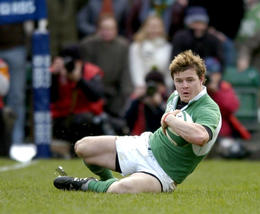
... and grounds the ball for a try seconds later.
The Irish supporters, who had been on tenterhooks all afternoon, roared out their relief and joy and headed for the pubs and clubs of Dublin -- there to celebrate the victory of the Boys in Green, and perhaps raise a quiet toast of gratitude to the referee, who had disallowed two questionable English tries. The English are still in an uproar over this, but their first try had been pretty shaky as well, when O'Gara had been tackled off the ball. Ah, sure, that's what's called the 'rub of the green': some days you get the decisions; others you don't. The lads played a blinder and they deserved to win.
Friday, February 25, 2005
157. The Ambassador
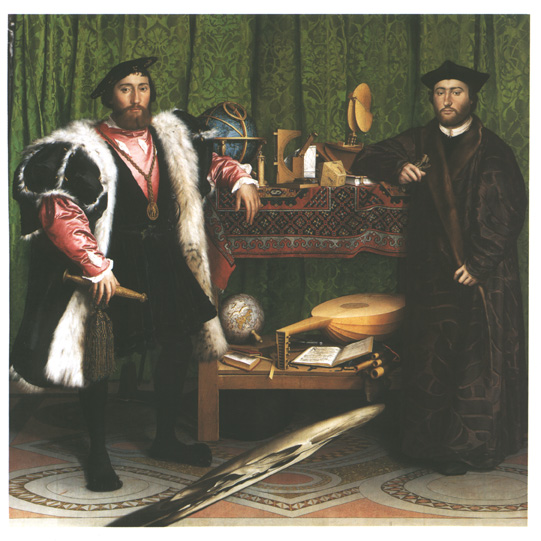
I.
Three days
they kept us waiting,
polite at all times,
correct, sympathetic,
yet adamant.
Our quarters
were quite luxurious,
our meals excellent;
the wines, delicacies,
rare and exquisite.
Impatience
gnawed at our bones;
confined to our quarters,
restless, testy, querulous,
as if with an itch
we could not scratch.
II.
Unexpectedly,
on the third evening
they summoned me,
the youngest, deaf to appeals
from my companions:
a long corridor
lined with tapestries,
thickly carpeted,
torch-lit, lightly scented,
a distant hint of music.
Gently disrobed
in a high-roofed antechamber,
led to a hall of sunken baths,
steaming, warm, and cold,
I was thoroughly scrubbed
by a host of attendants.
III.
Pinkly glowing,
every scrap of bodily hair,
save only the locks on my head,
closely shaved; protesting,
I was firmly over-ruled.
Shimmering robes
of deep-dyed purple silk,
buttersoft calfskin boots;
emeralds, winking rubies
on a diadem of beaten gold.
Pumice and powder,
a slow final application
of complicated scents,
mountain violets, ambergris, myrrh,
then placed in a palanquin
like a basket of new-laid eggs.
IV.
More waiting began;
straining my ears
I could barely ascertain
the coughs, the murmurs,
of otherwise silent bearers.
The high piping of flutes
sounded of a sudden closer,
underlain with a staccato beat
of tambourines, a throb of drums,
behind a deep uncanny drone.
Excitement
in some strange and unknown form
was building up close by;
drowsy, enervated, confused,
enclosed by silken walls,
I fell asleep.
V.
The official report
is to be my responsibility:
with no explanation given,
roughly, even rudely,
we were shoved upon the road.
My companions,
laughing at my appearance
when I was tipped back among them,
half-asleep, hairless, reeking of scent,
no longer speak to me.
The young princess,
the object of our journey,
is reported to have left the city,
hostile, cold, and angry.
My report requires great concentration,
a little nap will do no harm.
Subscribe to:
Posts (Atom)