Today is Bloomsday and also the fourth anniversary of this blog, begun on June 16 2004. There’s been a lot of water under the bridge since then, not to mention wars, hurricanes, tsunami, earthquakes, death of loved ones, emotional joinings and sunderings. During these four years I’ve posted something like 350 articles, poems, opinion pieces and general silly maunderings (the numbering scheme is close but inaccurate since I never really bothered to actually count from the beginning). There’s been something in the neighbourhood of 35,000 visitors, which works out to about 24 people a day. I’d just like to take the opportunity now to thank each and every one of those 24 people and gently urge them to take a break …
Anyway, it’s been fun and it’s created a public record of sorts (what was on the brain, for example, in January 2006?). And it’s not over, by any means. All that happens, really, is that we move on to the fifth year. Check in from time to time, if ou’re reading this. Failte Romhat, in the Irish – you’re always welcome!
Monday, June 16, 2008
Friday, June 13, 2008
333. stamping grounds

Down Knightsbridge way the other day
in my psychedelic condition
I moseyed slowly along the way
to a philatelic exhibition;
I had my tweezers in my hand
when I had to stop for the band
of the Royal Scots Guards
magnificent six-foot retards
prancing about for the English Queen
a lady I’ve talked to but never seen
when she rang me out of the blue
last Tuesday, I was home with the flu,
and asked was I the chap selling the Corgi
and I said no, that would be Georgie
and she said kaindly put him on the lain
and I said at the moment he’s not so fain
and I’m afraid in fact he’s beastly dead
since the 21 bus ran over his head
on his way home last night from the pub,
such a delightful charming musical Dub
and he in the street singing clear and strong …
Well, the draiver mustn’t have cared for the song
says the Queen, and then, Airish, I take it?
in that clippy little voice, you could not fake it,
and she hangs up on me, the snippy oul bitch,
my first (and last) contact with the rich.
The thing about stamps is
they’re such tidy little creatures,
just tiny little oblongs of gummy paper
that combine all the best features
of the crummy little countries they represent.
I floated along, I made no fuss,
and did not jump on a passing bus
out of respect for dear old Georgie
and the poor wee flattened Corgi.


Tuesday, June 10, 2008
332. Disneyworld with Joe
 (Joseph O'Connor, brother of the singer Sinead, is a well-known journalist and novelist in Ireland. He wrote a running account in the 'Sunday Tribune' newspaper of his misadventures in the USA while accompanying Irish fans to the 1994 World Cup which had the whole country laughing itself silly and became an instant classic. The following is an excerpt from the diary covering the day when Joe and some of the lads took a day off to visit Disneyworld in Orlando, Florida. Being able to guess what 'a ride' means in Irish slang sort of helps things along ....)
Our tour guide Wanda is waiting for us. Wanda is a very nice young woman from Kissimee. "There are some rully good rides here at The Magic Kingdom," she says, to a chorus of snuffles and titters. "We have big rides, small rides, scary rides, happy rides, whatever kind of ride you like you can find here at The Magic Kingdom." One fan is falling about the place now and another -- Crocko by name -- is laughing his bloody dentures out. Wanda must be wondering what it is she is saying that has all these grown men nearly widdling with laughter. But, true professional that she is, she continues.
"Er ... some of the rides have been here for a long time, but other rides are new, and here at Disney we're constantly looking at ways to make rides more exciting." The fans are slapping their thighs and guffawing at this stage. One usually quiet man from Laois is actually honking with laughter, throwing his ponderous head back and honking like a great big white-legged hysterical mallard duck. Honko, I'm going to call him from now on.
"What's so funny?" Wanda says.
"Nothing, Wanda," Honko replies.
"No, c'mon," she says, "Am I like, saying something funny?"
"Not at all, Wanda. You're grand, sweetheart. And c'mere, tellus, do you like the odd ride yourself, Wanda?"
"Oh yes, of course."
"And how many rides would you have a day?"
"Oh, I dunno, three or four I guess. Depends how much spare time I get."
Well, at this stage several of the fans have to go and sit down in the shade, or pour water over themselves, so frantic are their cackles. Some are actually sobbing with laughter. Donald Duck wanders over to one of them and begins gently to peck him on the head with his enormous yellow beak. "Go away ye big feathery fairy," the fan says. A hearty chant soon begins, the scheme of which is based on the considerable rhyming potential of the words Donald Duck. What a talent for poetry the Irish have! Seamus Heaney would have been proud.
Things are about to get even worse, however. An enormous structure depicting Mickey Mouse is pointed out on the horizon. Wanda tells us, her voice fairly brimming over with pride, "and guys, you know what, that's the largest self-supporting Mickey in the whole of the United States."
Well, I don't think I have to describe the communal reaction, really. It is as though the entire party has been blasted with laughing gas. Several of the supporters will need medical attention soon.
"Oh, there are other Mickeys," Wanda sniffs, dismissively, "there's a rully big Mickey in California, of course, and there are some rully large Mickeys in some of the other states, and a big old Mickey over there in Eurodisney. But I gotta tell you, we're real proud of our superb superbig Mickey that we got down here in Florida."
The sun is blazing hot now, and the white stone floor seems to be sucking the heat into itself. Tears of laughter are spilling down the faces of my companions. The seven dwarfs saunter past us, pursued by the mad hatter, the wicked witch of the west, the queen of hearts and various assorted fluffy tigers holding hands. The fans are chanting again now. "You'll never beat the Irish. You'll never beat the Irish." If Wanda smiles any harder, her eyebrows will disappear into her hairline. I close my eyes. I try to imagine just how much money you would have to spend on drugs to achieve this weird a feeling.
Monday, June 09, 2008
331. hometown (line edits)
original version:
I'm looking for a way
on this long and rocky road
between life and love
while the heart she
still stays pure, somewhere
between Inchicore and Terenure;
and I know you well, too well,
you shabby old city on the peatbrown Liffey,
so stony grey and sharp and blind,
and I pretend I do not mind
the apologetic smiling betrayals
that we all grow up with
under the shadow of your mountains
and never overcome.
edited version:
The heart is sound, the thoughts impure,
as I dance along the rocky road
from Inchicore to Terenure;
and I know you well, too well,
you shabby old city on the peatbrown Liffey,
so stony grey and sharp and blind,
and I pretend I do not mind
your apologetic smiling betrayals,
the memories we all grew up with
in the shadow of your mountains
and never overcame.
Monday, May 26, 2008
330. all else being equal
All else being equal,
I fear there is no sequel,
we have twenty-five thousand days
on this lovely damaged earth,
to shake and bake or make and break,
to live, enjoy or endure,
to seek perhaps the elusive cure
in moments of grace amid the strife
for the wonder we call life.
A concatenation of corpuscles,
skin and teeth, bones and muscles,
is this thing that you call Me,
and I call We,
never having perceived or believed
in any central unity.
So in a thousand different ways,
take your twenty-five thousand days
on this lovely damaged earth,
before you return
to the unknown bourne,
to the place you either were or weren't
before the gift of birth.
Take pleasure in waters flowing,
flowers growing
grass greening
mountains mountaining
steeples steepling
people peopling.
Saturday, May 24, 2008


Monday, May 12, 2008


Friday, April 25, 2008
327. fionnuala
all along the riverrun bawdy,
she sometimes leaves her lights on
then opens her window a wee little crack,
so as to let the ghosts get in
and let the ghosts get back;
sometimes she leaves her lights on,
all bright in a surrounding sea of black
along the river rank and tawdry,
and the ghosts float in and take their ease,
pale disembodied memories.
Sunday, April 20, 2008
326. Ireland in October
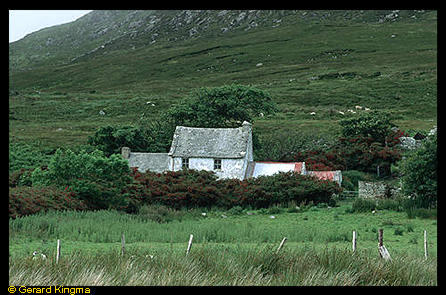
A cold fierce rain
lashes the windows;
pulling across the curtains
as the evening draws in,
we lay more sods of turf
upon the faintly flickering,
sputtering fire, then nurse
our drams of single malt.
We listen to, for we cannot ignore,
the half-human shrieks
of the wild Atlantic winds.
I don't know, says Uncle Liam,
how much of this you can understand.
Upstairs
in this whitewashed cottage
planted, perversely,
on the edge of nearly nowhere
sits a four-poster bed
with sagging springs
in a room no longer used
nor visited, occupied now
by dust and sepia photographs,
wherein the procreative urge
unleashed seven generations
of this failing family.
The pounding rain, the heartless wind,
now as in times past
and in the coming days to be,
deride our aspirations;
mock our faltering, our timid
sense of connection,
our humanity.
On that bedroom wall
housed in an ancient frame
is a faded stitching sampler:
"God Bless Our Happy Home",
piously, if a little uncertainly
accomplished, by her own hand,
by Emily May MacCarthy
on October 20, 1843.
She was the fifth of eleven children
and one of the seven
who starved to death
along with her despairing parents.
In the photographs, dapper
gentlemen with large moustaches
stare into the unforgiving lens
with set expressions
of puzzled defiance; they pose,
stiffly, among tasteful studio
backdrops: a small side table,
a pillar or two, potted palms.
James Boyle Roche. Photographer.
15 Bridge Street. Ennis
is stamped within an oval
in the corner: the building
still exists, the ground floor
is now a fast-food restaurant.
Wedding couples,
equally unrelaxed, stare
sightlessly from the past;
they stare at me across a canyon
of mutual incomprehension:
I could not even begin
to understand these people.
He sits, she stands,
but she places a tentative
pleading hand
upon his rigid manly shoulder.
There is another
strangely out-of-place picture
of my great-great-uncle Marteen,
shot dead in the civil war.
A cocky 24-year-old
with a cheeky grin,
he is brandishing
an enormous revolver
and smokes a jaunty cigarette.
I can tell from the look of him
we could have had a drink,
he would have cut through
the damp lace-curtain piety,
the respectability,the fear.
But the rain will have none of it:
it comes down in buckets,
it comes down in cascades.
You will never never
never be free, it says:
in this country you will
never be released.
Liam is uncharacteristically
subdued, even embarrassed:
he shifts from foot to foot, in front
of the now warm and blazing fire.
Upstairs
there are so many old photographs
here and there on the dresser,
even more on the sideboards:
cloche hats on smiling elegant women,
baggy suits on the gents, all caps and hats;
they grin and squint in the harsh sunlight
of those long forgotten days, sporting
fashionable shortened neckties:
my unknown, all but unknowable
dead ancestors.
A flicker of sympathy
if not of recognition
slips through
this threnody of regret.
Listen, I think I'm going to bed,
it's been a really long day, I say.
Liam frowns. An awkward
silence ensues: Emmmm ...
Listen to me. There's something
I really need to tell you.
It's about the family ....
Don't.
It will keep for another hundred years
Tuesday, April 15, 2008
325. Up to Tokyo for Kao's Wedding

The Band made the trip up to the Big Smoke last Sunday to play at Kao's reception. I came up by bus the previous day and spent a long liquid evening renewing acquaintance with Alan, the manager of Dubliner's in Ikebukuro, and met a number of other Irish lads who showed up, including Mike, who is pissed off big time with all the chaps in suits and significant neckties that pass for the Irish elite in Tokyo. He suggested a new organization called RIJ (Real Irish in Japan) and we all immediately agreed to join just to shut him up and get on with the pints and the talk. Good craic, and not a spot of bother with the head the next morning which is a sure guarantee the beer was good. The reception next day was held in a French restaurant, Chez Pierre, and I got talking to Pierre himself who hails from Brittany ("anozzer Kelt!!")and says he's been in Japan for 40 years.

The music went down well and we had to do several encores. Afterwards, Kenji & Koji and myself headed off for Paddy Foley's in Roppongi where we had a fair few jars and met Paul, the barman, who had just arrived in Japan six weeks ago. I gave Paul one of our homemade CDs to stick on -- and the manager came over and asked us to play a gig!! Ah, well, too bad we don't live in Tokyo. Not really, I can't stand the place ....!!


Tuesday, April 08, 2008
324. The Dark Ungentle Art of Murder

Love and death, possessing and killing,
Are the dark foundations of the human soul.
-- Emile Zola
O happy snappy little prole
Sign yourself upon the dole.
Go out on Friday, Saturday night,
And get yourself into a fight.
Smash the bloke who spills your drink,
Go with feelings, never think.
A pint glass is the warrior’s cup,
So chase the girls and knock ‘em up.
Social Services, police?
Wind ‘em up and never cease.
Football’s the modern field of battle,
So go in with your mates and rattle
Their cages. Towering rages
Make you a man among men!
And then, in a short while, when
Sadly you end up on a slab,
Sliced and diced by Dr. McNab
At the age of twenty, twenty-one,
You’ll have fought and you’ll have won
You little tit, your little bit
In restoring dear old Britain
To things that once were written
By poets and sages
About the Dark Ages.
John MacDonald found a corpse, put it under the sofa,
Waited till it came to life and hit it with a poker,
Sold its eyes for souvenirs, sold its blood for whisky,
Kept its bones for dumb-bells to use when he was fifty *.
George Tremayne was a man of fame
Well known in local parts;
He smiled and broke the young girls’ hearts,
But then broke one too many:
He seduced my sister Jenny.
Now George lies deep in the earth beneath,
I was grave and polite; I sent a wreath.
Unfriendly friendly universe,
I pack your stars into my purse
A weak cheer for our weary warriors
As they tread their hard way home;
Dispensers of Death, and yet,
It was through no wish of their own.
They are eager for love once more,
For simple acceptance; no foreign shore
Of unburied corpses, nor stink of war;
Eager to return to placid streams,
To ignore their dark unsettled dreams
And live as once they lived before.
But every man who was there can say
It never quite works out that way.
They need sweet sleep so badly,
And have no further wish to fight;
They would return their medals gladly,
For just one dreamless, peaceful night.
Every desire is a fear, every fear is a desire.
Doctor Mortimer duly arrived from Devon
On that clear September morning.
Holmes and I had had warning
But nothing under the canopy of Heaven
Could have prepared us for the Tale he told.
That Hound from Hell upon the Moors!
Heave aboot, ye Knaves and Hoors,
And roll them spittin’ cannons out!
Take aim, amidships, wait for the shout,
And dream on gold and jewels.
She would not think him half so cruel
Were she smiling prettily before him now
Instead of mouldering in the tomb;
Alive, at first, but with no room,
So very little room to move,
But time to think, before she died,
Of the earth and stones above her.
He had long since ceased to love her,
And arranged it all; if only to prove
The art of murder should best be applied
To enhance the fear of approaching doom.
Her fingernails torn to shreds, he imagines.
The darkness, the solitude, the weight:
Calculations of his cold dark hate.
He’s alive, he’s fuckin faking!
Chak ….. Chakka - Chak
Well, he’s f---in dead now.
-- US Marines, Fallujah 2004
Here’s a cracking new idea:
You ready?
- She’s a blonde/ brunette/ a redhead
- She’s young and sexy
- She’s got a filthy rich husband
- He’s old and fat
- She likes you
- She makes passionate love to you
- She says she adores you
- She wants you, needs you, etc.
- She begs you to kill her husband
- She’ll inherit the money
- You’ll wait until things cool down
- You’ll “meet”, you’ll get married
- You’ll live happily ever after
Me, I was in the Boy Scouts
So I know a thing or two,
( a couple of years in the Army as well,
but, truth to tell, Scouts is all you need
to learn depravity, get up to speed)
So this is what I’ll say to you:
She’ll be sitting on a sunny beach,
Out of call and out of reach,
Cuddling with her personal banker
While you, you trusting silly wanker,
Will be sprawled out at your leisure,
Doing 20 years at Her Majesty’s pleasure.
Dreamsister, dream once more of me
And I will sleepily dream of thee;
It is only in dreams my life has meaning,
When I hear you calling, softly keening.
Inchigeelagh.
My love and my mate
That I never thought dead
Till your horse came to me
With bridle trailing,
All blood from forehead
To polished saddle
Where you should be,
Either sitting or standing;
I gave one leap to the threshold,
A second to the gate,
A third upon its back.
I clapped my hands,
And off at a gallop;
I never lingered
Till I found you lying
By a little furze-bush
Without pope or bishop
Or priest or cleric
One prayer to whisper
But an old, old woman,
And her cloak about you,
And your blood in torrents –
Art O’Leary –
I did not wipe it off,
I drank it from my palms. **
Yuri Andeeivich Kostolenko
Is an ordinary Russian (Ukrainian) thug,
Wears a leather jacket, shades, a gold rolex,
And if you ask him he might shrug and flex
His muscular beefy arms, perhaps display
His shrapnel scars, the weird tattoos
He got when he and his mate Sergei
Were high as kites and on the booze
With Spetznatz in Afghanistan; Yuri smiles
And gazes three, four thousand miles.
He leaves this world behind. He is not unkind
To animals and little children, not on purpose,
But he will chop off your fingers with a cleaver,
Extract your teeth with pliers, connect live wires
To sensitive parts, or blandly stick a telephone receiver
Up your arse or down your throat. No use talking.
Yuri never listens: Dollars or Euros do the walking.
War was a game; this, the same: Bizzinez is Bizzinez.
Sobibor survivors testified at the trial that Stangl used to ride into the camp and attend ‘selections’ dressed in a white riding habit. ‘How could you go to the camp in that get-up?’ ‘The roads were very bad,’ he replied. ‘Riding was really the best mode of transport.’ I tried once more. ‘Yes, but to attend the unloading of these people who were about to die in a white riding habit …?’ ‘It was hot,’ he said.
-- Gitta Sereny interview with Franz Stangl, ex-SS commandant of Sobibor.
The clouds come drifting from west to east,
Other days they drift from east to west;
Armies come with them from both directions,
Not once, not twice, but many times:
Russia, Germany; and also, Sweden and Austria,
For sometimes the wind blows north and south.
You wouldn’t want to be a simple peasant
Exposed on this martial gathering ground;
And you really wouldn’t want to be a Jew,
Not if you knew what was good for you.
The autumn of ’39 came in like a thunderclap.
It was more, this time, than foreign uniforms,
Some new king squeezing the land for tax,
Much more, so very much more than that:
A half-cocked racial theory had landed.
Auschwitz – Oswiecim – sums it up for us now,
But many survived Auschwitz, hardly any survived
Maidenek … Sobibor … Chelmno … Treblinka.
The utter disgrace of Europe, of historical mankind,
Begins with the philosophes of Enlightened Paris
And ends, logically, in the killing sheds of Poland.
My job
Was to do what I was told.
And this is just totally unacceptable.
This is not only bad, it is wrong.
One of the real reasons we hate the Nazis …
Dislike the Germans, in fact, since Caesar’s time,
A people arrogant in victory, abject in defeat;
Either at your throat, or kissing your feet …
Is their planned, industrial approach to murder,
Their cold inhuman efficiency.
They make the rest of us look stupid
Or rather, make us look good by default:
We prefer to kill in the heat of the moment,
Or when we feel tired, upset, disgruntled,
Or because we received a shitty letter from home,
Or a lot of the time, too much of the time,
Because we are drunk.
Then we just want to forget all about it –
Come home to those placid streams,
Block out bad dreams.
But we rarely feel bad when our victims are unseen,
When there’s no personal memory of where we’ve been
Or of what we’ve done; we can drop a kiloton
Of bombs with mad persistence; from a distance
The blood and ruins, the scattered body parts,
Leave no scars upon our hearts.
We trained very hard for this mission and we knew what we had to do. When we pulled away from the target we were lifted up by a shock wave, and I knew in that moment that the mission was successful … When I looked down, what I saw was an area of roiling tar where before there was a city. Do I have any feelings of guilt? Well, I knew there were human beings down there and I felt sorry for them, but we were sent out to do a job and we did it. That’s the deal. Anyway, if it hadn’t been me somebody else would have done it.
-- Colonel Tibbets, commander of the ‘Enola Gay’.
Somebody else would have done it.
I suppose Genghis Khan, Tamerlane, could have said the same.
So could ‘Bomber Harris’, Dark Angel of Dresden.
So could so many others.
I think it’s a miracle to have made it this far,
All things considered. And also you, my friend,
Tu le connais, lecteur, ce monstre délicat,
—Hypocrite lecteur, —mon semblable, —mon frère!
Thank God (!) for the common sense of the Soviets,
Which is not quite as silly as is it sounds,
When one thinks of the people on ‘Our Side’.
O, God, sweet Mary Jane,
I saw you coming down the lane –
Smoke without fire.
We shall lie within a silken room
In Sidon or in royal Tyre,
Or if you will
In Notting Hill,
Wherever you desire.
Love, reign on me!
Reign over us all.
The man wanted for killing a British woman in a Tokyo flat had charmed her by sketching her portrait, police in Japan have said. Lindsay Hawker was beaten, stripped then strangled before being buried in a bathtub of sand, they added. It also emerged that chief suspect Tatsuyo Ishihashi had been warned in the past over claims he had stalked a young woman. Miss Hawker’s naked body was found in Ishihashi’s apartment on Monday.***
Japan is a doddle, so safe and so wonderful, so polite,
You just walk around in a daze of incomprehension
For the first few months; then the reaction kicks in
And you start to hate the place, since you think the locals
Are having a laugh at you, which, to be honest, they are,
And then it doesn’t matter because you hit your second wind,
And then you start to understand bits of the language,
And then you start to actually speak it a bit, which means
You meet all kinds of interesting new people, and, by then
My friend, you are hooked. You go home on holidays, sure,
But you always want to come back. It’s not exotic, like Thailand;
It’s totally straight down the line but like some other planet.
Imagine they wear a watch showing twenty-five hours in a day
And you are stuck with the good old traditional twenty-four;
So you are in line for some of the time, sometimes minutes away,
But never completely in synch. Yes, well, that’s my take on Japan.
They know exactly what’s going down and you don’t have a clue.
Some people freak and run home; the oddballs kind of like it.
Poor young Lindsay. What happened you?
Where was the back-up, the gaijin friends?
Can’t tell you the number of times when this rash poet,
Soi-disant, befuddled, s-s-s-slightly discombobulated,
Discerned menacing shadows perhaps closing in,
When a voice from the darkness called out,
‘Everything OK, mate? Put you in a taxi, orright?’
The moment of danger … if it was danger … is over.
So, Lindsay, what went down?
Where were your friends when you needed them?
Didn’t you know this geek meant trouble?
I will never know, and I can’t double-guess;
I never even knew you, and there are hundreds
Of girls like you, but none quite like you, and we didn’t
Even live in the same city, and so on and so on …
But I can tell you this, or tell your family,
That every gaijin guy in this country,
Surrounded by 125 million Japanese,
Hoards a nugget of shame, his share of the blame,
That we couldn’t do better,
That we couldn’t protect you.
-----------------------------------------------------------------------
Brief Notes and Links
* Extract from Bagpipe Music by Louis MacNeice.
** Extract from Caoineadh Airt Ui Laoghaire (The Lament for Art O’Leary)
*** The Lindsay Hawker case
There are some other short, usually italicized, quotes from Edwin Muir, James Fenton, Charles Baudelaire and The Who. For better or worse, everything else is my own.
Tuesday, March 25, 2008
323. Guinness Borracho!! - March 22
A great night in Shizuoka City brought Saint Patrick's Week to a close. Along with ourselves - the Gang from Hamamatsu - there were two other bands and the place was hopping. Tight music and a really good evening!!!!

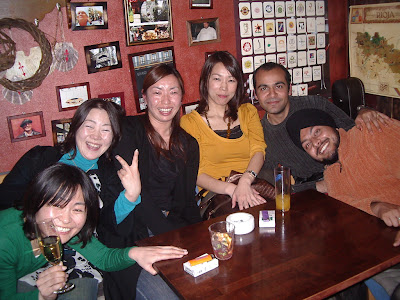



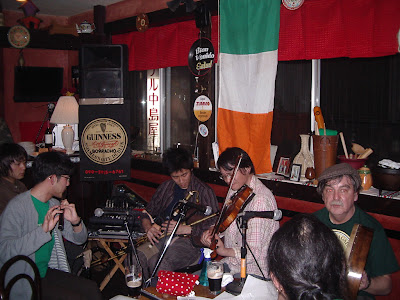
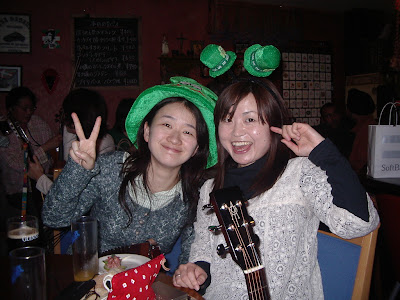
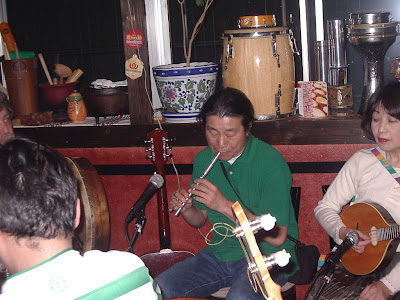
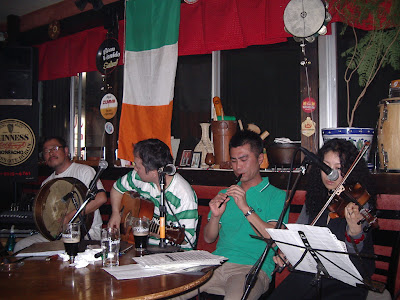
Click HERE for Web Album with loads more photos.


Click HERE for Web Album with loads more photos.
Thursday, March 20, 2008


Wednesday, March 19, 2008


Saturday, March 15, 2008
320.Beannachtai Na Féile Pádraig

Fad saol agat, gob fliuch, agus bás in Eirinn.
"Long life to you, a wet mouth, and death in Ireland."
Go raibh tú daibhir i mí-áidh
agus saibhir i mbeannachtaí
go mall ag déanamh namhaid,
go luath a déanamh carad,
ach saibhir nó daibhir, go mall nó go luath,
nach raibh ach áthas agat
ón lá seo amach.
May you be poor in misfortune,
rich in blessings,
slow to make enemies,
quick to make friends,
but rich or poor, quick or slow,
may you know nothing but happiness
from this day forward.
Má dhéanann tu séitéireacht,
go ndéana tú séitéireacht ar an mbás,
má ghoideann tú, go ngoide tú croí mná;
má throideann tú, go dtroide tú i leith do bhráthar,
agus má ólann tú, go n-óla tú liom féin.
If you cheat, may you cheat death.
If you steal, may you steal a woman's heart.
If you fight, may you fight for a brother.
And if you drink, may you drink with me.

Thursday, March 06, 2008
319. St. Paddy's Day is On the Way!
It's that time of year again. Oisin, the very best (if only) Irish band in town, will be playing a series of gigs during St. Patrick's Week, March 16-22. If you live locally, try to make it down. And wear something green ... or else. Or else what, exactly? Buy drinks all round is what!

March 16 (Sun.) - Chez Kao (7 pm - 11ish)
March 19 (Wed.) - Liquid Kitchen (9 pm - late)
March 22 (Sat.) - Guinness Borracho in Shizuoka City, with two other Irish bands. Starts at 7 pm.
Directions later, or check the Bandblog (in Japanese).

March 16 (Sun.) - Chez Kao (7 pm - 11ish)
March 19 (Wed.) - Liquid Kitchen (9 pm - late)
March 22 (Sat.) - Guinness Borracho in Shizuoka City, with two other Irish bands. Starts at 7 pm.
Directions later, or check the Bandblog (in Japanese).
Saturday, February 23, 2008

Thursday, February 21, 2008
317. Gaius Caecilius Metellus
Part the First: In which G. Caecilius Metellus embarks upon a public career.

(These events take place between the 681st and 685th year of the founding of Rome, from the consulship of L. Gellus and Cn. Cornelius Lentulus Clodianus to that of Q. Hortentius Hortalus and Q. Caecilius Metellus)
The envy of Peperna brought them low in the end;
too many drinks at a feast, a sudden flash of swords,
and in the passions born of burning jealousy,
the great general, Sertorius, was cruelly cut down.
I was then just a military tribune, rising nineteen,
under the command of my uncle, Metellus Pius;
when news of the murder made its way to our camp,
I was not the only young officer to sigh with relief.
Fighting in Spain had been harsh and unpleasant,
days of humping dry hills under a punishing sun;
lightning cavalry probes on our flanks, sudden panic,
dead companions, wounds, no trace of the enemy.
With the shrewd Sertorius gone, we soon wrapped it up,
although my laconic Uncle Pius reddened with rage
when Pompey (the ‘Great’) stole away with the credit;
as for me, I was delighted at last to sail home.
Ah, Rome!
You have no idea what it’s like to be back in the city,
to walk again the crowded, cacophonous, colourful streets;
to stroll in the Forum, linger lazily in the baths,
sleep with sultry and scented depilated girls!
My father, cold and stern in the approved old manner,
tipped me out of bed at sunrise on the third morning;
‘Holiday over,’ he grunted, as we stood in the cold atrium,
face to face with ancestral masks, ‘time to get cracking.’
So farewell to low taverns, to louche companions!
I notice, when you stand in the Forum on election morning,
that the white powder that gleams on your snow-bright toga
rises in little puffs, gets up your nose and makes you sneeze.
There I was, poised uneasily, on the bottom lowly rung
of the steep and seemingly lifelong cursus honorum,
a narrow, overcrowded, and quite often lethal ladder
that might lead one day to the dizzy heights of Consul.
I could see friends grinning up from the surging crowds,
as battered bones still ached from the ordeals of Spain;
my father’s clients milled about full of fussy attentions,
with such a formidable family, I had little chance of losing.
Duly elected quaestor, I was assigned to the Treasury,
about the most boring job you could possibly imagine;
daily I put my seal on whole streams of arcane documents,
presented and removed by dour and efficient silent slaves.
The sheer monotony of this unchanging daily routine
very soon made me frantic with the seeds of frustration;
I would slip away for the odd party or secret assignation,
but Boras, that bastard, would infallibly track me down.
Boras, ex-centurion, ex-primus pilus, far-too-loyal retainer,
son of a freedman who had once been slave to the family;
built from brick and scarred marble, doglike in his devotion,
he had no patience for ‘ softarse young pups on the town’.
In my experience, when your fortunes begin to sink low,
they have a way of descending into something far worse;
I’d only months left in the horrible job I’d been stuck with,
when Father announced yet another of his sleek notions.
‘There you are, son,’ he boomed, ‘gods above, you seem peaky!
‘I think it’s time we put a bloom on those pale pasty cheeks.’
O, gods, no, I thought, whatever this is, I really don’t want it!
‘I think it’s time,’ said the parent, ‘to think of your marriage.’
Boras, you evil old snitch, was my first conscious thought,
you ratted on my all-too-rare nights down in the Subura;
Boras’ eyes never once flickered in his long mahogany face,
so, then, I thought, it must be politics – isn't it always politics!
‘We need to steer a careful path,’ said Father, predictably,
‘between the remaining old supporters of Marius and Sulla ;
‘the family is not all that badly placed, but this could change,
‘we need to consider these rising men, Pompey and Crassus.
‘We connect with Pompey through your cousin,’ he continued,
‘But Crassus has no daughters!’ I cried out, without thinking;
this earned a frown from Father, an obelisk stare from Boras,
‘If you will allow me’, said Father, ‘I was thinking of the Julians.
‘But this fellow Caesar is a scheming villain, all piss and vinegar!’
‘He may prove successful, and there's a niece of some sort.’
My heart sank straight to my toes, like a heavy stone within me,
I knew all about young Julia, the ice-cold patrician princess.
I gazed blankly at my father, eyes heavy and dull with horror;
I felt transfixed, like one of the six thousand unfortunate slaves
that Crassus, not so long ago, had roped and nailed to crosses
and left to die, mile after mile of them all along the road to Rome.
‘Cheer up,’ said Father, ‘the betrothal is the thing, she is young.’
She is seven, I thought, which carries scheming a little too far.
‘We need to plan,’ he growled, ‘I command, and you will obey!’
Spain came first, then the Treasury, now this: I must get away.
-------------------------------------------------------------------------------
Brief notes:
- dates: approx. 72-69 BCE
- Sertorian War
- cursus honorarum: elected magistrates
- primus pilus: a sort of regimental sergeant-major
- Subura: a working class red light district in ancient Rome
The Metelli were a prominent senatorial family, conservative in outlook, but determined to preserve the Roman Republic as they understood it. They produced an impressive number of consuls and military leaders but were ultimately unable to prevent a showdown between the dignified political obtuseness of Pompey and the the unscrupulous political brilliance of Caesar, both powerful ambitious men with large armies to call upon. In a real sense, military expansion (the growth of empire) destroyed the republic, a lesson from history to any imperial power that masquerades as a republic at home.
See this article on the family
Part the Second: In which G. Caecilius Metellus abandons for a time his public career

(These events take place between the consulships of L. Caecillius Metellus and Q. Marcius Rex and those of L. Aurelius Cotta and L. Manlius Torquatus)
The quaestor’s job had been tiresome; now Father planned to marry me off,
and not just to anyone, either, he wished to forge an alliance with Caesar.
Much troubled, I went to seek advice from the celebrated M. Tullius Cicero,
whom I had watched, enthralled, during his masterly prosecution of Verres.
When I called on the great man, diffidently, his effusiveness surprised me,
but as a nobody from nowhere, he played up to the scions of older families.
I explained my awkward position and asked for the benefit of his thoughts:
‘Ah, dear impetuous youth,’ he sighed, then smugly intoned, ‘you must obey!’
I thanked him, strapped on my armour and breathlessly ran for the boats.
Quintus, another of my military uncles, had held out one chance of escape
before scheming Father, clutching my testicles, could approach wily Caesar
and offer my services, a sacrificial bull for Julia, his darling only daughter.
A fire-breathing response to what had been an offhand, half-hearted offer
visibly startled Uncle Quintus, this canny no-nonsense fleet commander;
as elder brother to Father, he was quick to understand the lie of the land,
and practically smacked his lips in composing a brusque and formal letter:
Hail, Brother! The People and Senate of Rome, in this hour of crisis,
look as ever to the bravery and fortitude of its young citizen officers,
among whom the fine young men of our family have always been …
Etc., etc.
We campaigned against the pirates of Crete, a bothersome nuisance,
and I found this to be refreshing, a form of violent outdoor exercise;
then, when an ill-planned raid went wrong, I received a slash across the guts
that came close to killing me, and for weeks I languished in some agony,
threatening to die if my worried uncle made an attempt to send me home.
Death passed me by with a whisper, but I knew it would find me in Rome
should I be connected to a woman that I cordially but intensely disliked,
and, more to the point, her ruthless father, who frankly terrified me!
I slipped ashore, a convalescent scholar, on sparkling peaceful Rhodes,
and applied to the school of Molon, former tutor to Cicero and Caesar;
‘Ordinarily, I wouldn’t do this,’ he said, accepting my lavish presents,
for he had cackled rudely at demonstrations of my "slow pedestrian mind”.
I wasn’t offended; I like the Greeks, they are subtle, quick and intelligent,
although incapable of practicalities, such as running their own country.
They make extremely useful slaves, unlike sluggish and belligerent Gauls,
and if you have the sense to flatter them, they can teach you a thing or two.
I took a liking to the local wines, and also to the habit of open discourse,
and was praised, I believe, as a mannerly young fellow, utterly un-Roman.
These were pleasant times, as the pirates faded entirely from view;
the task of clearing them I left to Uncle and, latterly, glory-seeking Pompey.
My father never ceased in his importunate efforts to summon me to Rome,
but well-paid local doctors sent him a series of discouraging reports.
Father recoiled with dread from any thoughts of ships or the sea,
thus I could laze to full recovery, attended by a pair of ravishing sisters.
I forget how long this leisurely life had lasted when it came to my notice
that young Roman visitors seemed to sport strange wispy little beards.
Romans have always been such a notoriously clean-shaven sort of people,
that I was intrigued by this change in fashion and sought these fellows out.
They spoke in reverent tones of some senator, a patrician named Catalina.
I had heard of him, of course, a grasping thug from one of the old families,
he had wilfully murdered for property at the time of Sulla’s proscriptions,
and, so it was said and believed, he had brutally murdered his very own son!
‘A great change will come to Rome,’ these young men were pleased to confide,
‘when all the landlords and lower-class moneylenders will meet their desserts;
'all the old families, the natural elite, will be restored to rightful power.’
Just so, thought I, calling for more wine, but what will Father make of all this?
Hardly a week had passed before his thoughts were forcefully made known.
A slave ran to my gate and delivered a letter from a ship newly docked:
‘Blast your silly wounds!’ it read. ‘Come back to Rome immediately!’
Father’s style, indubitably. Then: ‘I want you to befriend this man Catalina'.
Sunday, February 10, 2008
316. Lillibulero

Lily strolls saucily down the street
with slow embarrassed pleasure;
so young and alive in her new cotton dress,
the young lads watch her at their leisure.
Fairview, the Strand, Newcomen Bridge,
hear the trams come clanging down;
Amiens Street rises right ahead,
where trains rattle in to Dublin town.
O Lily, Lily, me Dublin darlin'
Lily, Lily bulero!
Talbot Street, shadow of the rail bridge,
alive with a load of little shops;
the cries and chants of the old street traders,
the roar of this city never stops.
Walk ahead, Lily dear, to Nelson's Pillar,
one-handled hero in a silly stone hat;
you'll meet your young man at a smart new cake shop,
but you're not quite sure what will follow from that.
O Lily, Lily, me Dublin darlin'
Lily, Lily bulero!
Sure, I don't even know if he's keen on me,
says Lily, agiggle with girlfriends;
he's never even tried to hold my hand,
sweet Lily, Lily bulero!
Now gaily she glides along the Strand,
as greyly the day slides into night;
the young chap that day, he was keen all right,
begorrah, bedad, and begum ...
now he's me Dad, and Lily's me Mum!
----------------------------
(true story !)
Friday, February 08, 2008
315. Foyle's War

Unquestionably, one of the best TV series going. Detective Chief Superintendent Foyle (Martin Kitchen) is based in Hastings on the southeastern coast of England when war breaks out in 1939. Intent at first in getting involved in the war in a more meaningful way, Foyle seeks a transfer from the humdrum police work of running down black marketeers and other petty criminals until murder and intrigue comes knocking at his door. Each episode in this series is a densely woven tale involving two or more subplots unfolding in tandem with the main action. There are no car chases or shoot-outs or any of the wham-bam action of a Hollywood thriller. Instead, the stories unfold with a seemingly leisurely but increasingly complex interplay of characters and events as the war progresses in the background, at first hardly noticeable but then intruding into the action more and more directly as the bombing intensifies and invasion fears increase. The attention to historical accuracy and period detail is extremely impressive with the mood of the series matching closely the popular literature and eyewitness reports of the wartime period. The clothing and the surrounding artifacts such as housing, interior fixtures, street architecture, notices and signs, and above all, the motor cars, are totally believable and one never gets the feeling of watching modern actors pretending to inhabit a recreated past. The characters and atmosphere bring the viewer straight back to the period in a fully believable way. Best of all, the stories are so subtle and so intelligently developed that the viewer before long begins to dread (with hindsight) the inexorable ongoing progress of the war since we all know it ended in 1945 ... and with it so will this series!
Subscribe to:
Posts (Atom)